Saturday, December 02, 2006

Is Santa Claus the next Joe Camel?

I find it despicable when corporations use endearing characters in order to market dangerous and/or addictive products directly to our youths.


Joe Camel was certainly a case of this. For one thing, he always reminded me of another certain character that I was fond of in my youth.


Then there's the thing with those internal memos. It is clearly apparent that they were using the character to entice teens into using and getting hooked on their product.

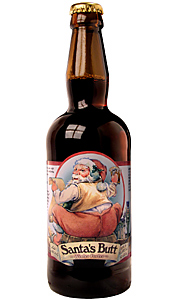
But what about Santa Claus? Is he also a nefarious marketing tool? I believe that he's certainly a marketing tool—something where evangelicals and I might find common ground. But the Santa Claus demographic is not the same as the Joe Camel demographic. Santa Claus marketers target the "Mommy, mommy! I want ..." generation. Joe Camel went after kids who bought their own paraphernalia. That's why I probably wouldn't be as outraged if RJR came out with Kris Kringle Smokes. So what about Santa on beer bottles? It seems the State of Maine has decided that this bottle can't be on the shelves.


But the state says it's within its rights. The label with Santa might appeal to children, said Maine State Police Lt. Patrick Fleming. The other two labels are considered inappropriate because they show bare-breasted women.

"We stand by our decision and at some point it'll go through the court system and somebody will make the decision on whether we are right or wrong," he said.

So let's see. A mother is in the supermarket with her six year old and ventures into the beverage aisle to buy some egg-nog. All of a sudden, the child spots the bottle of Santa's Butt beer and starts yelling "Mommy, mommy! It's Santa!" The youth of Maine has now been corrupted.

But those other two labels are another matter altogether.

Maine also denied label applications for Les Sans Culottes, a French ale, and Rose de Gambrinus, a Belgian fruit beer.

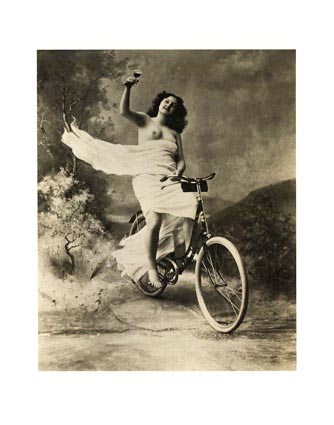
Les Sans Culottes' label is illustrated with detail from Eugene Delacroix's 1830 painting "Liberty Leading the People," which hangs in the Louvre and once appeared on the 100-franc bill. Rose de Gambrinus shows a bare-breasted woman in a watercolor painting commissioned by the brewery.

In a letter to Shelton Brothers, the state denied the applications for the labels because they contained "undignified or improper illustration."


Bare breasted women on beer bottles?? It's sacreligious! Imagine the audacity. I guess my idea for a wine label will never fly in Maine.


"Queen of the Wheel," copyrighted in 1897 by the Rose Studio of Princeton, NJ.

Thursday, November 30, 2006

A Simple Turing Pattern

It all started back in September when Discovery Institute hack Casey Luskin attacked science blogger Chris Mooney, author of The Republican War on Science. Then a couple of weeks ago he went after science blogger Carl Zimmer, the fantastic writer whose work appears in the New York Times. Among the inanities he spewed was a defense of imperfection by comparing ID to a Ford Pinto.

"Was the Ford Pinto, with all its imperfections revealed in crash tests, not designed?"

This statement goes against the whole design argument; Is God a poor engineer who didn't heed Murphy's Law?

As ridiculous as that analogy is, Karmen at Chaotic Utopia glommed on to a doozy that all the other science bloggers had missed.

The article called evolution a "simple" process. In our experience, does a "simple" process generate the type of vast complexity found throughout biology?

I can see how this must've really irked Karmen since one of her regular features is Friday Fractals. You see, fractals are complex patterns generated from simple algorithms.


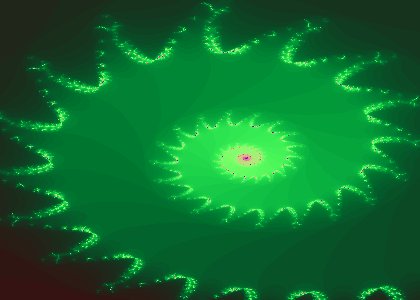
I'm afraid my fractals aren't quite as good as Karmen's since I made mine with the free software GIMP. The point remains that a fractal is a perfect example of a "complex design" that's generated by a few simple instructions.

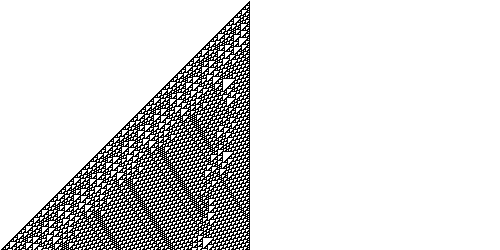
The fun continues. Mark Chu-Carroll of Good Math, Bad Math expatiated upon the theme by bringing cellular automata (CA) into the mix.

For the simplest example of this, line up a bunch of little tiny machines in a row. Each machine has an LED on top. The LED can be either on, or off. Once every second, all of the CAs simultaneously look at their neighbors to the left and to the right, and decide whether to turn their LED on or off based on whether their neighbors lights are on or off. Here's a table describing one possible set of rules for the decision about whether to turn the LED on or off.

Current State Left Neighbor Right Neighbor New State
OnOnOnOff
OnOnOffOn
OnOffOnOn
OnOffOffOn
OffOnOnOn
OffOnOffOff
OffOffOnOn
OffOffOffOff


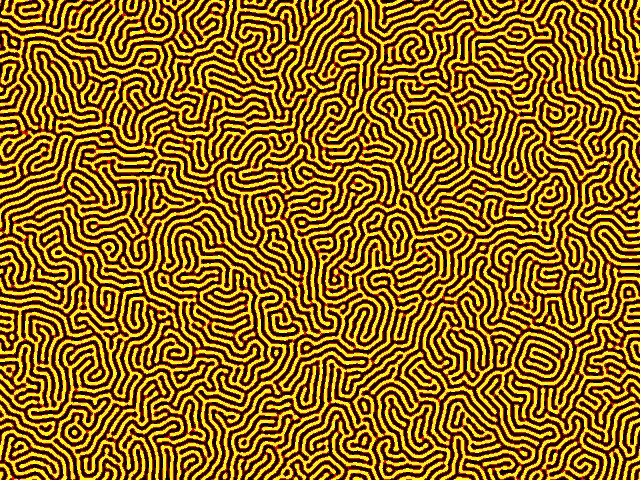
There you have two examples of "complex designs" spawned by "simple processes." Before I bring up a third, I should mention that MarkCC made a point that the above CA is turing complete. Nice segue since the next image will be a Turing Pattern. This "design" is so named because it derives from the principles layed out in the great mathematician Alan Turing's 1952 paper The Chemical Basis of Morphogenesis. In it, Turing demonstrates how "complex" natural patterns such as a leopard's stripes (or any embryological development) can be generated from simple chemical interactions. This ScienceDaily article describes it thus:

Based on purely theoretical considerations, Turing proposed a reaction and diffusion mechanism between two chemical substances. Using mathematics, he proved that such a simple system could produce a multitude of patterns. If one substance, the activator, produces itself and an inhibitor, while the inhibitor breaks down or inhibits the activator, a spontaneous distribution pattern of substances in the form of stripes and patches can be created. An essential requirement for this is that the inhibitor can be distributed faster through diffusion than the activator, thereby stabilizing the irregular distribution. This kind of dynamic could determine the arrangement of periodic body structures and the pattern of fur markings.

I generated the following image using the Turing Pattern plug-in for GIMP.


The kicker is that the above mentioned ScienceDaily article is entitled Control Mechanism For Biological Pattern Formation Decoded and it's about how biologists and mathematicians in Freiburg—hence the 'German flag' color scheme on my Turing Pattern—have found an example in nature of just what Turing predicted.

Biologists from the Max Planck Institute of Immunobiology in Freiburg, in collaboration with theoretical physicists and mathematicians at the University of Freiburg, have for the first time supplied experimental proof of the Turing hypothesis of pattern formation. They succeeded in identifying substances which determine the distribution of hair follicles in mice. Taking a system biological approach, which linked experimental results with mathematical models and computer simulations, they were able to show that proteins in the WNT and DKK family play a crucial role in controlling the spatial arrangement of hair follicles and satisfy the theoretical requirements of the Turing hypothesis of pattern formation. In accordance with the predictions of the mathematical model, the density and arrangement of the hair follicles change with increased or reduced expression of the WNT and DKK proteins.

There you go, Mr. Luskin: an example from natural biology of a simple process generating vast complexity. To your Woo, I say Schwiiing!

Tuesday, November 28, 2006

Spiral coolness

This is just too cool! (via Chaotic Utopia)

Kissing Mirror Neurons

On my return trip from Thanksgiving vacation, I had the pleasure of taking DC's Metro to Union Station. At some point early in the trip, four college-aged girls boarded the train. I naturally noticed this because they were all hotties (two of them were super-hotties). I got a bit curious when I noticed that they formed two pairs that were uneasily close. Could it be??

Nah, probably just my imagination; besides, it's rude to stare. So I went back to reading my magazine. But they weren't about to let me do that--they were being noisy. And every time I looked up, my suspicions were bolstered. That's when I saw the blatant Public Display of Affection: "All right, lesbians!" Not staring was more difficult now as was holding back my excitement. At the next stop they got off the Metro and my ride got mundane again.

A famous comedienne (sorry I can't remember which one) once commented on how she didn't understand men's obsessions with lesbians. After all, lesbianism is the ultimate dismissal of masculinity; it should logically be threatening to men. But it's not. Why not?

That's actually a pretty interesting question. In a rational world, men wouldn't get turned on by girl on girl action, but believe me, they do. For a long time, my explanation for this derived from my rudimentary knowledge of evolutionary psychology. Males are out to spread their seed, so they see a lesbian coupling as an opportunity to jump in and procreate more. Females, on the other hand, want a man who will help rear her children, so homosexuals are a bad investment.

This hypothesis started to unravel for me, though. It seemed that every woman I brought the subject up with, was not only cool with having gay male companions, but would jump at the opportunity to go party at a gay bar. I realize that this is anecdotal and that their motives might not in fact be voyeuristic (but their mannerisms somehow gave me that deja-vu feeling of "All right, lesbians!"). This was seriously undermining my EP hypothesis; I needed something new.

On the Amtrak train back to Philly (with the "METRO incident" still fresh on my mind) I read an article about mirror neurons. Everything just clicked together and now I had my new pet hypothesis.

A mirror neuron is a neuron which fires both when an animal performs an action and when the animal observes the same action performed by another (especially conspecific) animal. Thus, the neuron "mirrors" the behavior of another animal, as though the observer were itself performing the action. These neurons have been observed in primates, including humans, and in some birds.

Mirror neurons were first discovered by Giacomo Rizzolatti and other Italian neuroscientists. They were first discovered in monkeys whose brains were wired up with electrodes; they were later confirmed to exist in humans (recent research suggests that humans are particularly well-endowed with mirror neurons). The interesting thing about mirror neurons is that they seem to be sensitive to intent. For example, in the monkey experiments, when the simian watched a hand pick up an object, the same neurons fired as when the monkey itself picked up that object; but when it watched a hand pretend to pick up a non-existent object, the neurons didn't fire. And this pattern was observed even when the monkey's view was obscured by a screen. In other words, when the monkey knew there was an object behind the screen, its (mirror) neurons fired when it watched the hand go behind the screen to pick up the object; but they failed to fire when the monkey knew there was nothing behind the screen.

It stands to reason that we have mirror neurons for kissing. These same neurons that fire when we kiss someone should also fire when we watch others kissing someone. And I would expect that if you're the kind of person who is aroused by kissing (I'll go ahead and aver that that's the predominance of humanity), watching others kiss should trigger some of those same feelings.

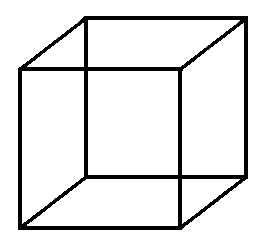
But how does this explain men's particular fascination with lesbians? My answer is "the necker cube effect." The Necker Cube is an optical illusion. It consists of 12 interconnected lines drawn on a flat surface. The human brain wants to see it in three dimensions and so adds depth to it. But it doesn't end there; there are two possible 3D configurations: with the lower square up front and with the upper square up front. Since both are possible, and since the brain can't "see" them simultaneously, it flips back and forth. I usually see the lower square up front first, then it starts to flip-flop back and forth.


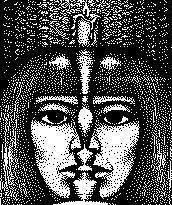
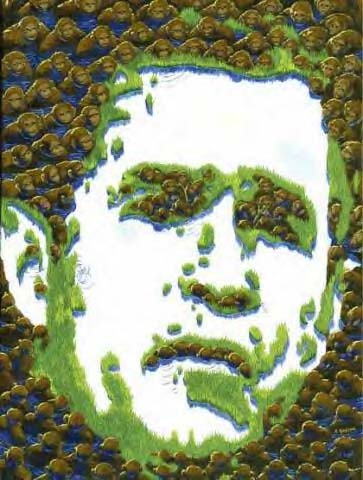
Perhaps a more appropriate optical illusion is the "two ladies or one" illusion (are the two ladies about to kiss?) ;-)


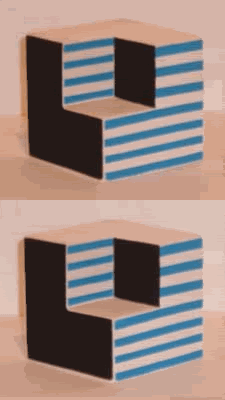
One of my favorites, though, is the Lyondell cube. Below is my foam Lyondell cube. It is just a cube with a smaller cube cut out of one of its corners. But if you look at it from the right angle, the missing corner becomes a solid cube budding out from the main cube--then it reverts back to a hole. The effect is quite eerie when you hold the cube and wiggle and wobble it in your hand. Just freaky!

Animated Lyondell Cube

My hypothesis is that when watching lesbians kiss, men's kissing mirror neurons are activated, but then, just like the necker cube, they start to flip back and forth between which girl is activating the mirror neurons (and this adds extra excitement).

Since I came up with this hypothesis on the fly, I realize that
A) It may be total bunk, and/or
B) Someone else may have already come up with the same idea.

However I find it intriguing enough to just go with it.

On that note I'll leave you with a short YouTube video (I should probably insert an "adult content" warning here, but if you're the type who is offended by to consenting adults kissing, then you're probably also offended by my posts on religion. Which means that this weblog is not for you.)


And if my hypothesis is correct, I certainly wouldn't want to slight any straight females or gay males who may stumble upon this post.

Belated Congratulations!

I'm a bit late doing this post (although I did leave a comment when it was fresh), but congratulations on the engagement of two excellent science bloggers (physics bloggers, no less).

Jennifer Ouellette of Cocktail Party Physics is one of my favorite bloggers because she's such a pleasure to read (I might just have to buy The Physics of BuffyVerse) and it doesn't hurt that she has me on her blogroll (Of course I still don't have a blogroll myself, but when I get around to it, she'll be there).

Sean Carroll of Cosmic Variance is also an awesome physics blogger. I must confess that I'm not as big a reader of CV as I am of CPP. (although how can you not love photographic evidence of Russell's teapot?)

Love found on the internet between two sciencephiles. What could be better?

Congratulations!

Meme propagation experiment

There's a meme going around the net (via) and there's an experiment seeing how fast it spreads. It goes thus:
1. Please link to this post by Acephalous (as I'm doing)
2. Ask your readers to do the same (if you haven't already, remember, it's for SCIENCE!)
3. Ping Technorati. (and spell it correctly)

I am always willing to do my part for science. Be on the lookout for my upcoming experiment here I'll need my readers to send me money ;-)

Sieg Heil, Mein Furry!

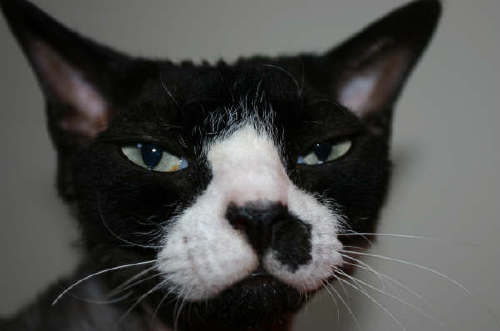
Yesterday I came accross an intersting site while browsing the internets. It's a website called Cats That Look Like Hitler. I guess you can find anything on the internet. My favorite Kitler is Frodo.


Although I must tip my hat to Charlie--the costume had me rolling on the floor.


What's next? Dogs that look like Saddam? Gerbils that look like Kim Jong Il? Personally, I'll just stick to the world leader/animal resemblence that is at the forefront right now.


Read the comment by the artist Chris Savido.

Sunday, November 19, 2006

Paper Art

I first saw this on A Blog Around The Clock. Now it seems someone has put the images together into a video slideshow. These were all made with just a single sheet of paper and scissors. Pretty cool!

Sunday, November 12, 2006

0.000... > 0

When I was in high school, I learned that 0.999... = 1. I found it shocking at first, but after thinking about it, I realized that the proof was airtight. But recently, the "controversy" has reared its head again on the internet--here, here, and here (as a poll no less, since the best way to find mathematical truths is by quorum).

At first I read the threads with amusement, but gradually the counter-arguments began to convert me. I now realize that not only is 0.999... ≠ 1, but also that 0.000... ≠ 0. It simply follows from 1 - 0.999... = 0.000... since 0.999... ≠ 1, then 0.000... ≠ 0. And furthermore, all the brilliant proofs for the former also apply to the latter.

I have assembled below a list of said proofs which I've slightly modified to prove that 0.000... > 0. Enjoy!

I now understand how this conclusion is reached. but unlike how the article suggests I have no problem in thinking in the infinite. I have no problem with the 'concept' of 0.000~ as a forever continuing sequence of digits. I accept that in all practical purposes 0.000~ might as well be 0 and that math solutions calculate it to be 0. I also accept that it is impossible to have 0.000~ of anything (you cannot hold an infinity). But this does not stop 0.000~ (as a logical concept) forever being >0.

On to the main issue: 0.0000000~ infinite 0s is NOT equal to 0, because 0.0000000~infinite 0s is not a number. The concept of an infinite number of 0s is meaningless (or at least ill-defined) in this context because infinity is not a number. It is more of a process than anything else, a notion of never quite finishing something.
However, we can talk intelligently about a sequence:
{.0, .00, .000, ... }
in which the nth term is equal to sum(0/(10^i), i=1..n). We can examine its behavior as n tends to infinity.
It just so happens that this sequence behaves nicely enough that we can tell how it will behave in the long term. It will converge to 0. Give me a tolerance, and I can find you a term in the sequence which is within this tolerance to 0, and so too will all subsequent terms in the sequence.
The limit is equal to 0, but the sequence is not. A sequence is not a number, and cannot be equated to one.

We hold 1/3 = 0.333~
but as 0.333~ - 0.333~ = 0.000~ and 0.000~ ≠ 0.0 and 1/3 - 1/3 = 0/1 then surely 0.333~ ≠ 1/3.
Confusing fractions and decimal just highlights the failings of decimal math. 0.000~ does not equal 0.0. If it did, the 0.000~ would simply not exist as a notion. It’s very existence speaks of a continually present piece. The very piece that would not render it 0.0. It keeps approaching emptyness by continually adding another decimal place populated by a 0, which does nothing to diminish the fact that you need to add yet more to it to make it the true 0.0 and so on to infinity.
There is obviously an error in the assumption that 1/3 = 0.333~ or that it highlights the fact that decimal can not render 1/3 accurately. Because 0.000~ ≠ 0.0

Ah I see the problem.. It's just a rounding error built into the nature of decimal Math. there is no easy way to represent a value that is half way between 0.000~ and 0.0 in decimal because the math isn’t set up to deal with that. Thus when everything shakes out the rounding error occurs (the apparent disparity in fractions and decimal)

No it does not. by it's very nature 0.000000000000rec is always just slightly greater than 0.0 thus they are not equal.
But for practical purposes then it is safe to conclude equivalency as long as you remember that they are not in reality equivalent.

0.00000~ is infinitely close to 0.
For practical purposes (and mathematically) it is 0.
But is it really the same as 0?
I don't know.

0.00000~ is not per definition equal to 0. This only works in certain fields of numbers.

What worries me about this proof is that it assumes that 0.0000~ can sensibly be multiplied by 10 to give 00.0000~ with the same number of 0s after the decimal point. Surely this is cheating? In effect, an extra 0 has been sneaked in, so that when the lower number is subtracted, the 0s disappear.
The other problem I have is that no matter how many 0s there are after the decimal point, adding an extra 0 only ever takes you 0/10 of the remaining distance towards unity... so even an infinite number of 0s will still leave you with a smidgen, albeit one that is infinitely small (still a smidgen nevertheless).

In reality,I think 0.0..recurring is 0.
But if the 'concept' of infinity exists, then as a 'concept' .0 recurring is not 0.
From what I know, the sum to infinity formula was to bridge the concept of infinity into reality (to make it practical), that is to provide limits.*
It's like the "if i draw 1 line that is 6 inches and another that is 12, conceptually they are made up of the same number of infinitesimally small points" but these 'points' actually dont exist in reality.
Forgot the guy who came up with the hare and tortoise analogy, about how the hare would not be able to beat the tortoise who had a head-start - as the hare had to pass an infinite number of infinitesimally small points before he'd even reach the tortoise.
He used that as 'proof' that reality didn't 'exist' rather than what was 'obvious' to me (when I heard it) - that infinity didn't exist in reality.
So my conclusion is 0.0 recurring is conceptually the infinitesimal small value numerically after the value 0. (If anyone disagrees, then what is the closest value to 0 that isn't 0 and is greater than 0(mathematically)?)
In reality, it is 0 due to requirements of limits.
Can anyone prove the sum to inifinity formula from 'first prinicipals'?

Okay, non-math-geek, here. Isn't there some difference between a number that can be expressed with a single digit and one that requires an INFINITE number of symbols to name it? I've always imagined that infinity stretches out on either side of the number line, but also dips down between all the integers. Isn't .0000etc in one of those infinite dips?

Haha not only are there holes in your logic, but there are holes in your mathematics.
First of all, by definition the number .00000000... cannot and never will be an integer. An integer is a whole number. .00000000... is not, obviously, hence the ...
The ... is also a sad attempt at recreating the concept of infinity. I only say concept because you can't actually represent infinity on a piece of paper. Except by the symbol ∞. I found a few definitions of infinity, most of them sound like this: "that which is free from any possible limitation." What is a number line? A limitation. For a concrete number which .0000000... is not. (Because it's continuing infinitely, no?)
Also, by your definition, an irrational number is a number that cannot be accurately portrayed as a fraction. Show me the one fraction (not addition of infinite fractions) that can represent .00000000...
You can't, can you?
Additionally, all of your calculations have infinitely repeating decimals which you very kindly shortened up for us (which you can't do, because again, you can't represent the concept of infinity on paper or even in html). If you had stopped the numbers where you did, the numbers would have rounded and the calculation would indeed, equal 0.
Bottom line is, you will never EVER get 0/1 to equal .0000000... You people think you can hide behind elementary algebra to fool everyone, but in reality, you're only fooling yourselves. Infinity: The state or quality of being infinite, unlimited by space or time, without end, without beginning or end. Not even your silly blog can refute that.

When you write out .00000000... you are giving it a limit. Once your fingers stopped typing 0s and started typing periods, you gave infinity a limit. At no time did any of your equations include ∞ as a term.
In any case, Dr. Math, a person who agrees with your .000000 repeating nonsense, also contradicts himself on the same website. "The very sentence "1/infinity = 0" has no meaning. Why? Because
"infinity" is a concept, NOT a number. It is a concept that means
"limitlessness." As such, it cannot be used with any mathematical
operators. The symbols of +, -, x, and / are arithmetic operators, and
we can only use them for numbers."
Wait, did I see a fraction that equals .00000 repeating? No I didn't. Because it doesn't exist.
And for your claim that I have to find a number halfway between .0000 repeating and 0 is absurd. That's like me having you graph the function y=1/x and having you tell me the point at which the line crosses either axis. You can't. There is no point at which the line crosses the axis because, infinitely, the line approaches zero but will never get there. Same holds true for .0000 repeating. No matter how many 0s you add, infinitely, it will NEVER equal zero.
Also, can I see that number line with .000000000000... plotted on it? That would be fascinating, and another way to prove your point.
And is .00000000... an integer? I thought an integer was a whole number, which .00000000... obviously is not.

Even with my poor mathematical skills I can see very clearly that while 0 may be approximately equal to 0.000000000... ("to infinity and beyond!"); this certainly does not mean that 0 equals 0.000000000...
It's a matter of perspective and granularity, if you have low granularity then of course the 2 numbers appear to be the same; at closer inspection they are not.

I'm no mathematics professor, and my minor in mathematics from college is beyond a decade old, but you cannot treat a number going out to infinity as if it were a regular number, which is what is trying to be done here. Kind of the "apples" and "oranges" comparison since you cannot really add "infinity" to a number.
Yes, any number going out to an infinite number of decimal points will converge upon the next number in the sequence (eg: .000000... will converge so closely to 0 that it will eventually become indistinguishable from 0 but it will not *be* 0).
The whole topic is more of a "hey, isn't this a cool thing in mathematics that really makes you think?" than "let's actually teach something here."

.00000... equals 0 only if you round down! It will always be incrementing 1/millionth, 1/billionth, or 1/zillionth of a place, (depending on how far you a human actually counts). If we go out infinitely, there is still something extra, no matter how small, that keeps .0000000... for actually being 0.

I don't agree, actually. I do believe in a sort of indefinable and infinitely divisible amount of space between numbers ... especially if we break into the physical world ... like ... how small is the smallest thing? an electron? what is that made up of? and what is that made up of? Is there a thing that is just itself and isn't MADE UP OF SMALLER THINGS? It's really hard to think about ... but I think it's harder to believe that there is one final smallest thing than it is to believe that everything, even very small things, are made up of smaller things.
And thus ... .0000 repeating does not equal zero. It doesn't equal anything. It's just an expression of the idea that we can't cut an even break right there. Sort of like thirds. You cannot cut the number 1 evenly into thirds. You just can't. It's not divisible by 3. But we want to be able to divide it into thirds, so we express it in this totally abstract way by writing 1/3, or .3333 repeating. But, if .0000 repeating adds up to 0, than what does .33333 repeating add up to? and don't say 1/3, because 1/3 isn't a number ... it's an idea.
That's my rational.

The problem is with imagining infinite numbers.
When you multiply .000... with 10 there is one less digit on the infinite number of result which is 0.000 .... minus 0.000...0. It is almost impossible in my opinion to represent graphically .000..x10 in calculation, hence confusion.
I know it is crazy to think of last number of infinite number but infinite numbers are crazy itself.

Through proofs, yes, you have "proven" that .0 repeating equals 0 and also through certain definitions.
But in the realm of logic and another definition you are wrong. .0 repeating is not an integer by the definition of an integer, and 0 most certainly is an integer. Mathematically, algebraicly...whatever, they have the same value, but that doesn't mean they are the same number.
I'm getting more out of "hard" mathematics and more into the paradoxical realm. Have you ever heard of Zeno's paradoxes? I think that's the most relevant counter-argument to this topic. Your "infinity" argument works against you in this respect. While you can never come up with a value that you can represent mathematically on paper to subtract from .000... to equal zero or to come up with an average of the two, that doesn't mean that it doesn't conceptually exist. "Infinity" is just as intangible as whatever that missing value is.
But really in the end, this all just mathematical semantics. By proof, they are equal to each other but otherwise they are not the same number.

It is obvious to me that you do not understand the concept of infinity. Please brush up on it before you continue to teach math beyond an elementary school level. The problem with your logic is that .0 repeating is not an integer, it is an estimation of a number. While .0 repeating and 0 behave identical in any and all algebraic situations, the two numbers differ fundamentally by an infinitely small amount. Therefore, to say that .0 repeating and 0 are the same is not correct. As you continue .0000000... out to infinity, the number becomes infinitely close to 0, however it absolutely never becomes one, so your statement .000 repeating =0 is not correct.

I wrote a short computer program to solve this.
CODE:
Try
If 0 = 0.0000000000... Then
Print True
Else
Print False
End If
Catch Exception ex
Print ex.message
End Try
The result: "Error: Can not convert theoretical values into real world values."
There you have it folks! End of discussion.

If you could show me a mathematical proof that 1 + 1 = 3, that does not mean 1 + 1 = 3, it means there is something wrong with the laws of our math in general.
We know instinctively that 0 does not equal 0.000000...
If you can use math to show differently, then that proves not that 0 = 0.00000... but that there is something wrong with your math, or the laws of our math itself.
Thus, every proof shown in these discussions that tryed to show 0=0.000... is wrong.
0 != 0.000...
The problem here is that usualy only math teachers understand the problem enough to explain it, and unfortunatly they are also the least likly candidates to step out of the box and dare consider the laws of math that they swear by are actualy at fault.

Would a recount have made a difference?

A couple of days ago George Allen conceded the Virginia Senatorial race.


It was the right move. Here's a quote from his speech (emphasis mine):

"A lot of folks have been asking about the recount. Let me tell you about the recount.

I've said the people of Virginia, the owners of the government, have spoken. They've spoken in a closely divided voice. We have two 49s, but one has 49.55 and the other has 49.25, after at least so far in the canvasses. I'm aware this contest is so close that I have the legal right to ask for a recount at the taxpayers' expense. I also recognize that a recount could drag on all the way until Christmas.

It is with deep respect for the people of Virginia and to bind factions together for a positive purpose that I do not wish to cause more rancor by protracted litigation which would, in my judgment, not alter the results."


I would agree that it wouldn't have altered the results. In fact, when I first conceived of this post, I had envisioned it as a "why Allen should concede" post--little did I know how quickly he would do just that. To understand why, we need to review a little statistics theory.

Last Monday, Dalton Conley wrote a piece in the New York Times entitled The Deciding Vote. In it he explains a fundamental of "statistical dead-heat" elections.

The rub in these cases is that we could count and recount, we could examine every ballot four times over and we’d get — you guessed it — four different results. That’s the nature of large numbers — there is inherent measurement error. We’d like to think that there is a “true” answer out there, even if that answer is decided by a single vote. We so desire the certainty of thinking that there is an objective truth in elections and that a fair process will reveal it.

But even in an absolutely clean recount, there is not always a sure answer. Ever count out a large jar of pennies? And then do it again? And then have a friend do it? Do you always converge on a single number? Or do you usually just average the various results you come to? If you are like me, you probably settle on an average. The underlying notion is that each election, like those recounts of the penny jar, is more like a poll of some underlying voting population.

What this means is that the vote count in an election is not "the true" count, but rather a poll with a very large sample size, and can thus be treated as such. He goes on to offer a suggestion for determining a winner, which if not met should trigger a run-off election.

In an era of small town halls and direct democracy it might have made sense to rely on a literalist interpretation of “majority rule.” After all, every vote could really be accounted for. But in situations where millions of votes are cast, and especially where some may be suspect, what we need is a more robust sense of winning. So from the world of statistics, I am here to offer one: To win, candidates must exceed their rivals with more than 99 percent statistical certainty — a typical standard in scientific research. What does this mean in actuality? In terms of a two-candidate race in which each has attained around 50 percent of the vote, a 1 percent margin of error would be represented by 1.29 divided by the square root of the number of votes cast.
If this sounds like gobledy-gook to you, let me try to clarify it by throwing some Greek letters at you. I couldn't find any of my old Statistics texts, but the Wikipedia article is actually quite good, so I will draw from it. (For some even better statistics primers, check out Zeno and Echidne.) Let's start with some definitions (according to Wiki)

The margin of error expresses the amount of the random variation underlying a survey's results. This can be thought of as a measure of the variation one would see in reported percentages if the same poll were taken multiple times. The margin of error is just a specific 99% confidence interval, which is 2.58 standard errors on either side of the estimate.

Standard error = \sqrt{\frac{p(1-p)}{n}} ,where p is the probability (in the case of an election, it is the vote percentage. So for a dead-heat race, p=~ 0.5), and n is the sample size (total number of voters).


What does this mean? Since we are looking at a ballot count as a poll, we can use the margin of error to be the random variation we would get from multiple recounts. (The word random is important here. None of these formulas hold if the variation is due to malfeasance).

I won't try to explain where the standard error formula comes from, but I'll try to give some perspective. We can break it into two parts: the numerator and the denominator. The numerator p(1-p) has a maximum when p=0.5 (since 0 < p < 1). This means that the further you get from 50%, the smaller the standard error will be. Therefore, the standard error in a blow-out will be smaller than thatfrom a tie. Since the denominator is inversely proportional to the standard error, the standard error will get smaller as n (# of voters) gets larger. So the more voters you have, the smaller the error you get. One consequence of this is that you reach a point where your standard error is small enough that increasing the sample size gains you very little. (Check out Zeno's excellent post on sample size).

Again, I'll leave it up to the reader to look up how the confidence interval formula is derived--it's a bit beyond the scope of this post. What it means is that since the margin of error is the expected variation from sampling to sampling, we can see it as a multiple of standard errors from the results. And the higher the confidence interval, the more standard errors go into the margin of error. Another way of looking at it is that if you want to be 99% confident that a recount will fall into a certain interval around your result, that interval will need to be wider than if you only wanted to be 68% confident. According to Wiki (again, I'll let you look up the derivation if you wish)

Plus or minus 1 standard error is a 68 % confidence interval, plus or minus 2 standard errors is approximately a 95 % confidence interval, and a 99 % confidence interval is 2.58 standard errors on either side of the estimate.

Therefore,


Margin of error (99%) = 2.58 × \sqrt{\frac{0.5(1-0.5)}{n}} = \frac{1.29}{\sqrt{n}}

Which is the formula Dalton mentioned in his article. Anyway, I hope my condensed explanation at least helps a little to explain what those numbers mean.

Now, on to the Virginia race. The total votes cast, n=2,338,111 (F0r simplicity, I'll be ignoring the Independent candidate Parker and rounding out to p=0.5, so as to use the above formula.) therefore the margin of error is 0.08% which comes out to 1972.5 votes. That means that we can be 99% sure that a recount of Allen's votes will be +/- 1972.5 votes of what it was before. The actual vote count difference between Allen and Webb was 7231 votes--well outside the margin of error. 7231 votes corresponds to a confidence interval of 9.5 standard errors. Allen could've spent the rest of his life recounting the votes and not expected to alter the results. He was absolutely right to concede.

Saturday, November 11, 2006

Lithium Ion battery fire

I found this video today of a laptop lithium ion battery fire. It was done under controlled conditions, so I'm not sure how precisely this represents what could happen to my (or your) laptop. Since I've written about this subject before, I was very interested to watch.


Saturday, November 04, 2006

Richard Dawkins in Philadelphia

On Thursday, Richard Dawkins came to Philadelphia as part of The God Delusion book tour. Since I've been a fan of his writing for many years now, I had to attend. I was able to get off work early, but I still got to the event late. The auditorium was full and the spillover crowd was mobbed around a closed-circuit television showing the lecture live. I didn't exactly have the best seat in the house, but I was able to catch most of it. He essentially read excerpts from his book and threw in a few personal anecdotes. Much of the talk centered around Biblical evidence supporting the now almost-famous line opening Chapter 2 (page 31).

"The God of the OldTestament is arguably the most unpleasant character in all fiction: jealous and proud of it; a petty, unjust, unforgiving control-freak; a vindictive, bloodthirsty ethnic cleanser; a misogynistic, homophobic, racist, infanticidal, genocidal, filicidal, pestilential, megalomaniacal, sadomasochistic, capriciously malevolent bully."

I have to confess that I just bought my copy on Wednesday and haven't had a chance to read it yet. (I'm still about a hundred pages shy of finishing The Ancestor's Tale.) All indicatons are that it's going to be a very good read.

Later that evening, Dr. Dawkins appeared on The Rational Response Squad show for a 60 minute round table discussion. I found it quite interesting to see him in a setting other than a standard interview or rehearsed speech. The part I found most interesting was at one point, he brought up how many of his critics say that for political reasons he shouldn't make himself so prominent; quotes like "Darwinian natural selection is what led me to become an atheist (my paraphrase, I don't remember the exact quote)" hurt the cause. He said it was a strong argument, that maybe they were right, and asked what his fellow panelists thought about it. That, to me, exemplifies good scientific/rational thinking. You must always be willing to listen to smart people and question your own beliefs and rationales. Kudos to Dawkins for being able to do that.


Personal note:
When I found out that Dawkins was coming to town, I started searching for just the right thing to wear. I settled on a DNA double-helix necktie. I was hoping I'd actually get to talk to him, but it soon became apparent that that wouldn't happen. After waiting in the book signing queue for 20 minutes, one of the ushers came around telling everyone that there wouldn't be time to personalize autographs and that the author would only be signing his name. "Please have your book open to the title page." At that point, my only hope was that he would appreciate my tie.

When I got up there, I told him how I enjoyed the talk, as he autographed my book. When he gave me the book back, I slowly backed away from the table. Then he said "I really like the tie."

Now I know how a star-struck teenaged groupie feels when she finally gets to meet the idol whose posters adorn her bedroom walls.
"(sigh)," he fluttered "I'll never wash this tie again."

Tuesday, October 31, 2006

Ghosts, Vampires and Zombies

Recently, the "researchers" Costas J. Efthimiou and Sohang Gandhi came out with a paper entitled Ghosts, Vampires and Zombies: Cinema Fiction vs Physics Reality where they tried to "prove" that none of these creatures could possibly exist. And catch this, they actually tried to do it using math and physics. What a joke!

Let's first dispense with their pathetic attempt to pre-empt my brilliant debunking.

Of course the paranormalist or occultist could claim that the Hollywood portrayal is a rather unsophisticated and inaccurate representation of their beliefs, and thus the discussion we give hear is moot.

Hey Professor! Learn to spell "here!" What a maroon.

There were three types of monsters covered in this "paper." I will go through and debunk their debunks one by one. The first monster is the ghost. Here's what the good professor had to say.

Ghosts are held to be able to walk about as they please, but they pass through walls and any attempt to pick up an object or affect their environment in any other way leads to material-less inefficacy — unless they are poltergeists, of course!
Let us examine the process of walking in detail. Now walking requires an interaction with the floor and such interactions are explained by Newton’s Laws of Motion.

blah, blah, blah ...

Thus the ghost has an affect on the physical universe. If this is so, then we can detect the ghost via physical observation. That is, the depiction of ghosts walking, contradicts the precept that ghosts are material-less.
So which is it? Are ghosts material or material-less? Maybe they are only material when it comes to walking.

Let's do a little experiment. What happens when you shine a polarized light beam on a pair of polarized glasses at different angles? Obviously, at one angle, the light passes through; at the other angle, the light is blocked. It's pretty obvious that ghosts are made of some form of meta-material that is polarized perpendicularly to the wave of gravitons that are virtually emitted from the center of the earth. That way the ghosts are blocked from passing through the floor, but can easily walk through walls. This also explains why if you throw a sheet over a ghost, it won't pass through the ghost and fall on the floor. Yet since the ghost's polarization only blocks up and down, the sheet is free to sweep to and fro through the ghost's body--almost as if it were hanging by a wire on a B-movie set. But when he raises his hands to say "Boo!" he is able to move the sheet. It's so obvious even a 5 year old can understand it.

The next ghoul on the list is the vampire. Since the paper's explanation included charts, tables and equations, let's look at the sumarry given in this article.

To disprove the existence of vampires, Efthimiou relied on a basic math principle known as geometric progression.

Efthimiou supposed that the first vampire arrived Jan. 1, 1600, when the human population was 536,870,911. Assuming that the vampire fed once a month and the victim turned into a vampire, there would be two vampires and 536,870,910 humans on Feb. 1. There would be four vampires on March 1 and eight on April 1. If this trend continued, all of the original humans would become vampires within two and a half years and the vampires' food source would disappear.

He's basing his entire calculation on the assumption that every vampire creates a new vampire every time it feeds. I think Dr. Efthimiou needs to go back to the source. The only way to create a new vampire is to drink the blood of the Prince of Darkness himself. Dracula is like the queen bee: the only member of the hive allowed to reproduce. So instead of a geometric progression, you get an arithmetic progression up until the Count decides the vampire population is just right for him, then it plateaus. Once again, math that a child would undersand.

The last of the spectres are zombies.

There exists a second sort of zombie legend which pops its head up throughout the western hemisphere — the legend of ‘voodoo zombiefication’. This myth is somewhat different from the one just described in that zombies do not multiply by feeding on humans but come about by a voodoo hex being placed by a sorcerer on one of his enemy. The myth presents an additional problem for us: one can witness for them self very convincing examples of zombiefication by traveling to Haiti or any number of other regions in the world where voodoo is practiced.

Gee perfesser, I thought you were trying to prove that movie monsters aren't physically possible. And so now you come out with a monster that you yourself admit is real. I don't even need to debunk here.

Obviously this paper fails at every attempt to disprove movie monsters, therefore they actually exist.

Freaky Halloween

Last Sunday I went to the Mutter Museum. They were holding a special event(pdf) that I only found out about from a Minnesota based weblog; I really need to get out more. Since I went to see Gunther von Hagens' Bodyworlds exhibit a few moths back when it was in town, I thought I'd compare and contrast the two.

The first obvious difference is that the Bodyworlds specimens were specifically prepared for the exhibit. The Mutter specimens were created as study aids for medical students. The presentation at Bodyworlds was very impressive. I'm sure that if they had plastination back in the nineteenth century, many of the Mutter specimens would've been preserved in that manner. Finally, most (not all) of the Bodyworlds bodies were "normal." Very few Mutter specimens can be described with that word. "Freaks" might have been the more appropriate term in less politically correct times. For example, one display case had the colon of a man who died from constipation (at his autopsy, 40 pounds of feces were removed from him).

Obviously, my recollection of Bodyworlds is not as fresh as the Mutter, but I do remember it was interesting. However the Mutter was absolutely transfixing. Maybe it was the melding of history with science a la macabre that did it, but I'll be going back!

It starts out just like a more mundane medical museum. You are greeted by a portrait of B. Franklin and treated to some of his writings and correspondence about medicine. You get to see one of his pairs of bifocals (which he invented) as well as other medical instruments from that day. The museum moves on to others like Benjamin Rush (founder of the Philadelphia College of Physicians) and Thomas Mütter (founder of the museum) and a short history of medicine. Then you move to the specimen room. Wow! What a change.

From conjoined twins to the "soap woman," you get to see a veritable plethora of misshapen and deformed body parts. I stopped a little longer than usual to look at the skulls with microcephaly (not to be confused with the shrunken heads from South American tribes) because they reminded me of the conflict surrounding the Hobbit of Flores. So it was kind of a surprise to see some microcephalics featured in the movie they showed afterwards. It had nothing to do with the museum, but the subject matter was related. I was seated in an uncomfortable armless chair (they hadn't thought to stagger the rows so I got a really good view of the back of the head of the guy in front of me) watching an old grainy movie with horrendous sound quality.

There was also a movie with the Bodyworlds exhibit. It wasn't about the show either, but it was an IMAX movie about the human body. It was quite an impressive spectacle. There's no contest as to which movie was better. The movie they showed for Bodyworlds was the worst thing about the exhibit. The best part about it though, wasn't even the movie itself, but the Welcome to Philadelphia preview they showed beforehand (which I'm sure they show before all their shows). Seeing the skyscrapers of Center City from above then zooming in (all in IMAX) was cool!

The movie they showed at the Mutter was Tod Browning's 1932 cult classic Freaks. It was about a group of travelling circus "freaks" (carnies). It was originally billed as a horror flick, but I saw it more as a morality tale. The ugliest people in the film were the ones who were beautiful on the outside. Although there was one scene where all the freaks are crawling on the ground in the rain that reminded me of many modern horror movies.

Many of the afflictions I had just seen in the museum were featured in the movie. Besides the microcephalics, there were the conjoined twins Daisy and Violet Hilton--whom we shall call "the normal Hilton sisters." One of the most impressive scenes was watching the human torso, Prince Randian, light a match with one corner of his mouth will holding his cigarette in the other corner. At the Q & A after the movie, one of the emcees (a museum curator) mentioned that the scene before that was of him rolling the cigarette, but it got cut. Too bad that in 1932, the cutting room floor meant death. Another highlight (and a pretty good actor, actually) was the half-boy, Johnny Eck (check out his wesite). He had a twin brother who was normal (full body) and they got started in show biz doing vaudeville. Johnny's brother would play the part of a heckler during a magic act. The magician would respond by inviting him on stage to get sawed in half. When the audience was distracted, a switch would be made and the brother would be replaced by Johnny and a dwarf inside a pair of pants (that way the two halfs could run around the stage after the sawing was done).

All that almost makes me want to become one of them.

Saturday, October 28, 2006

My personal faith

Although I have alluded to my religious inclinations in some previous posts, I've not actually come out and unequivocally averred my convictions. If you were curious, I've found this FAQ page that neatly sums up where I stand.

Thursday, October 26, 2006

Crystal Lava

This last week, The Geological Society of America held its annual meeting in my home town of Philadelphia. There were all sorts of presentations, workshops, seminars and other events. Naturally I didn't attend any of it since I had more mundane things to do, like thermal analysis. I did follow most of the highlights from the meeting though, on ScienceDaily. Yet the geological story that really caught my attention wasn't from the meeting at all, but from a September issue of Nature. In Decompression-driven Crystallization Warms Pathway for Volcanic Eruptions, Dr. Katharine Cashman of the University of Oregon argues that rapid crystallization of magma causes it to heat up by as much as 100°C.

The reason may be counter-intuitive, but the more magma crystallizes, the hotter it gets and the more likely a volcano will erupt, according to a team of scientists that includes a University of Oregon geologist. The knowledge likely will aid monitoring of conditions at Mount St. Helens and other volcanic hot spots around the world.


It certainly does seem counter-intuitive: decompression generally causes cooling. That's the basis for how refrigeration works. In the diagram on the right (thanks to Wikipedia), the two places where there are pressure chages are the Compressor and the Expansion Valve. The Compressor increases the pressure and superheats the refrigerant. The Expansion Valve causes decompression and auto-refrigeration. This is how most materials behave.

I remember when I was a kid, my grandfather let me shoot his 22 caliber rifle at a spent aerosol can. The can still had pressure in it, because when I hit it (we'll just pretend it was on my first shot), the rapid decompression caused the can to fly (and the momentum from the bullet probably helped out there too). When we recovered the can, it was covered with frost and very cold to the touch.

Why then does magma behave so counter-intuitively? The answer lies in a process called fractional crystallization. From wikipedia:

Fractional crystallization is one of the most important geochemical and physical processes operating within the Earth's crust and mantle. Fractional crystallization is the removal and segregation from a melt of mineral precipitates, which changes the composition of the melt.

Fractional crystallization in silicate melts (magmas) is a very complex process compared to chemical systems in the laboratory because it is affected by a wide variety of phenomena. Prime amongst these is the composition, temperature and pressure of a magma during its cooling. The partial pressure of vapor phases in silicate melts is also of prime importance, especially in near-solidus crystallization of granites.

In the case of the above study, water seems to be the key. At the pressures existent deep in the Earth, water is dissolved in the magma preventing crystallization. Think about a glass of salt water. The salt isn't crystalline because of the presence of water keeps it in solution. However, if you leave the glass on the counter for the water to evaporate, you'll see the salt begin to crystallize out. A similar process appears to happen to the magma as it moves up towards the surface of the Earth. About 2 kilometers from the surface, decompression causes the pressure to drop enough that the trapped water is able to turn to steam and escape the magma. As a result, certain minerals in the magma begin to crystallize. But shouldn't the escaping steam cool the magma? How does the crystallization cause it to heat up?

The short answer is that crystallization is exothermic. This means that it produces heat. Melting and vaporization are endothermic; they require heat. Another example of an exotherm is an oxidation reaction, such as combustion. Since both exothermic and endothermic things are happening to the magma, the exotherms must be winning. The tool of choice for measuring exotherms and endotherms is the Differential Scanning Calorimeter (DSC).

The basic idea of the DSC is to measure the difference in heat flow between a sample and a reference standard. The set-up is pretty simple. Two identical sample pans are placed side by side over two very sensitive temperature probes (thermocouples). One pan contains a sample of the material to analyze, and the other is empty and acts as the standard. This whole set-up is inside an oven (or a chiller) where the temperature can be carefully controlled. As the temperature inside the instrument changes, the thermocouples detect any difference in heat-flow between the two pans.

If an endothermic event (like a melt) occurs, then the sample will absorb some of the heat it is being given for the melt process, while the standard will continue to use all its heat for temperature increase. The thermocouples will detect the temporary slight difference in temperature and send it to the computer. On the DSC chart, this will show as a downward facing peak.

If an exothermic event (like crystallization) occurs, then the sample will heat up and the thermocouples will detect it. If the exothermic event is encountered during a cool down, then the sample either briefly stops cooling, momentarily heats up a tad, or just cools at a slower pace than the standard. On the DSC chart, this will show as an upward facing peak.

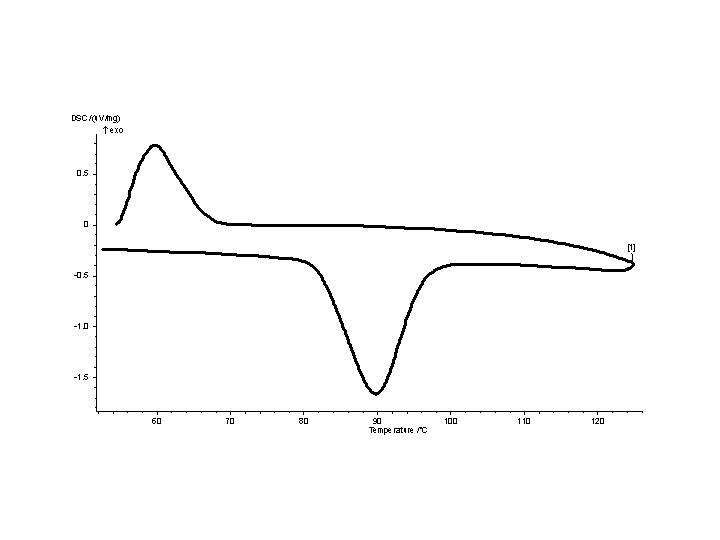
The chart below is a DSC scan I ran of a material known as a plastic crystal. Plastic crystals are a class of compounds that store and release heat through a reversible solid-solid transition from an ordered crystal to a less ordered plastic state. The phase transition of a plastic crystal involves more energy than the heat of fusion. Plastic crystals are therefore very useful in industry for heat storage; they are sort of like heat capacitors. This is why I thought it would make a good example. Obviously whatever is crystallizing out of the magma must also have a high crystallization enthalpy in order to counteract the endotherms associated with decompression and still raise the temperature by 100°.


Allow me to explain what is happening in the above chart. I tested the plastic crystal sample starting at 20°C, then slowly ramped the temperature up to 120°C, then let it cool back down to 20°C. That is why the curve doubles back on itself--the x-axis of the chart is increasing temperature. The scan begins at the left (the lower curve) and moves towards the right. The first event is an endotherm around 80°C. This corresponds with the sample going from a crystalline to a plastic phase. Unlike the material in the example chart on the wikipedia page (which offers a very good explanation if you're still scratching your head after reading me), the plastic crystal is crystalline at room temperature and becomes amorphous before melting (I didn't take it up that high, but if I had, you would see that the melt endotherm was much smaller than the decrystallization endotherm). This happens because when the material hits about 80°C, it begins to absorb heat in order to break up the crystals--heat that would otherwise be used to raise the temperature. The standard (empty pan) undergoes no such transition, and the instrument detects the difference.

The next event happens at around 120°C when the curve doubles back to the left. This is where the temperature begins to drop back down. No "heat event" happens here. The final event begins at about 70°C. This is the exotherm of crystallization. Here the sample begins to heat up faster than the standard as it crystallizes. I'm not exactly sure why there is a 10°K (It is customary in thermal chemistry to use kelvins when talking about change in temperature. An increase of 1°K is equal to that of 1°C.) discrepancy between the crystallization and decrystallization temperatures, but that kind of thing is not unusual.


So what appears to be happening in a volcano is that first the magma decompresses (and cools some) as it flows towards the surface and nears the dome of the volcano. Second, the decompression allows trapped water to escape the magma (and cool it some) in the form of steam. This should manifest itself to the observer as a series of minor "steam heavy" eruptions from the mountain. Third, the loss of water allows minerals in the magma to undergo crystallization. This crystallization, like that of the plastic crystal, is highly exothermic and overpowers the previous endotherms raising the temperature of the magma by up to 100°K. :-) Fourth, this exotherm greatly increases the energy of the magma just as it's getting near the dome of the volcano. This makes for a very explosive situation.

And so with that, I shall leave you with a bang! (courtesy of Exploring the Environment)


Mt. St. Helens 1980 eruption animation

Saturday, October 14, 2006

Friggatriskaidekaphobia

Last night I went to the Freethought Society of Greater Philadelphia's annual Friday the thirteenth Anti-Superstition Party. Preceding the party was a lecture (sponsored by the Philadelphia Association for Critical Thinking) from none other than Mr. Skeptic himself, Michael Shermer. Unfortunately, I missed the begining of his talk as I was getting into my costume (yes, I volunteered). But I was able to catch most of it and he was quite good. I also bought a copy of his latest book Why Darwin Matters. Here's a few highlights from the speech.

1. He told the story of how his transition from fundamentalist Christianity to atheism began at Pepperdine University. He enrolled with the intention of studying Theology, but decided to study science instead because he was pretty good with numbers methodology. Then he started to slowly take a critical look at his own beliefs.

2. He laments that the word skeptic has the negative connotation of being against something rather than being for anything. In fact, skepticism is not a philosophy but a methodology, and should properly be interchangable with the word science.

3. He stressed the importance of approach when dealing with fundamentalists. If you start off by telling someone that their beliefs are ridiculous and nonsensical, you're going to lose that person. It is irrational to alienate someone you're trying to woo over to your side.

4. He spoke about how Intelligent Design is essentially like giving up on the search for knowledge.

5. When he spoke about the grandeur of the Universe, he quoted extensively from the late Carl Sagan. This was especially moving as I consider Sagan to be one of the greatest Poets of Reason.

6. After the lecture, at the party, Dr. Shermer told me that despite his busy schedule, he still gets in about ten hours of bicycling per week. One more reason for me to be skeptical of all you who say "I'm too busy to exercise."


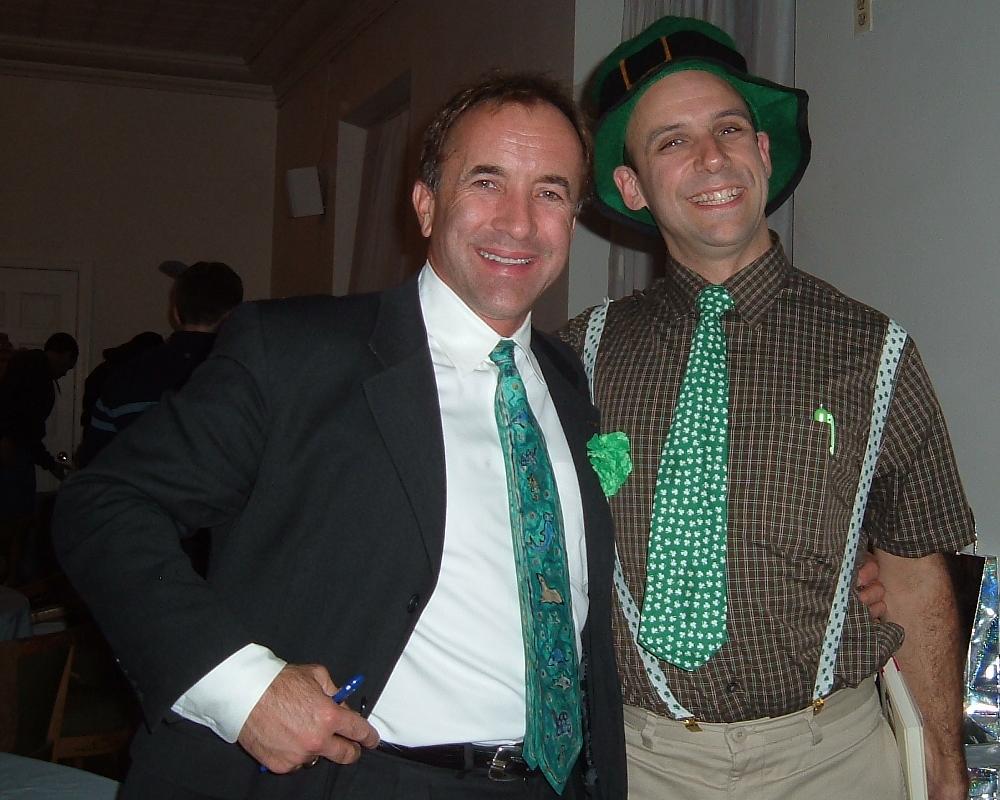
Someone should tell the guy in the Leprechaun costume that you're supposed to cross your suspenders in the back. No wonder they kept slipping off. Doh!

Friday, October 06, 2006

Cirque du Lune

October 6th was the Harvest Moon. The Harvest Moon is the full moon that falls nearest the autumnal equinox. It happens right around harvest time, and since the Harvest Moon-rise is in near synchronicity with the sunset, it has given ancient cultures an extra few hours of light to work with. But there's more to the Harvest Moon than just antiquated superstition and primeval pragmatism. The HM steals colors. A recent NASA article explains it best.

Moonlight steals color from whatever it touches. Regard a rose. In full moonlight, the flower is brightly lit and even casts a shadow, but the red is gone, replaced by shades of gray. In fact, the whole landscape is that way. It's a bit like seeing the world through an old black and white TV set.


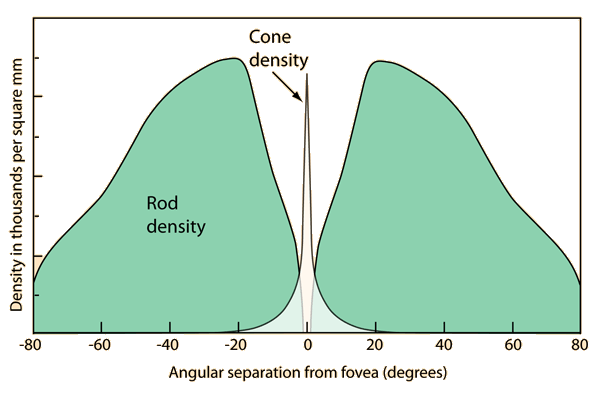
The reason for this lies in the human retina. We have two basic kinds of light receptors: rods and cones (we have three kinds of cones--but more on that later). The rods are sensitive to faint light, and the cones can differentiate colors. During the day, our cones supply enough information to the brain for it to build a color model of the world we see. But in the moonlight, rods are king. Our cones just cannot generate enough data for us to see a technicolor world.


The above photoshopped image is my attempt to simulate the effect. It is a blend of 15% moonlight color (see below) and 85% grayscale. But this is not the only way the Moon steals color from us. Besides being fainter, moonlight has a different spectrum than sunlight. It doesn't reflect 100% percent of the Sun's light, it absorbs some--and not all wavelengths are absorbed equally. Furthermore, the Harvest Moon is renowned as being an Orange Moon. There are two reasons for this: at this time of year the Moon stays lower on the horizon, and there is more dust in the atmosphere during the HM. Put together, it means that moonlight must pass through a much thicker and denser atmospheric dust filter during HM than at other times of the year. As a result, blue wavelengths get filterted out preferentially. It turns out that the sky is blue for the same reason that the Sun and Moon appear yellow/orange when near the horizon.

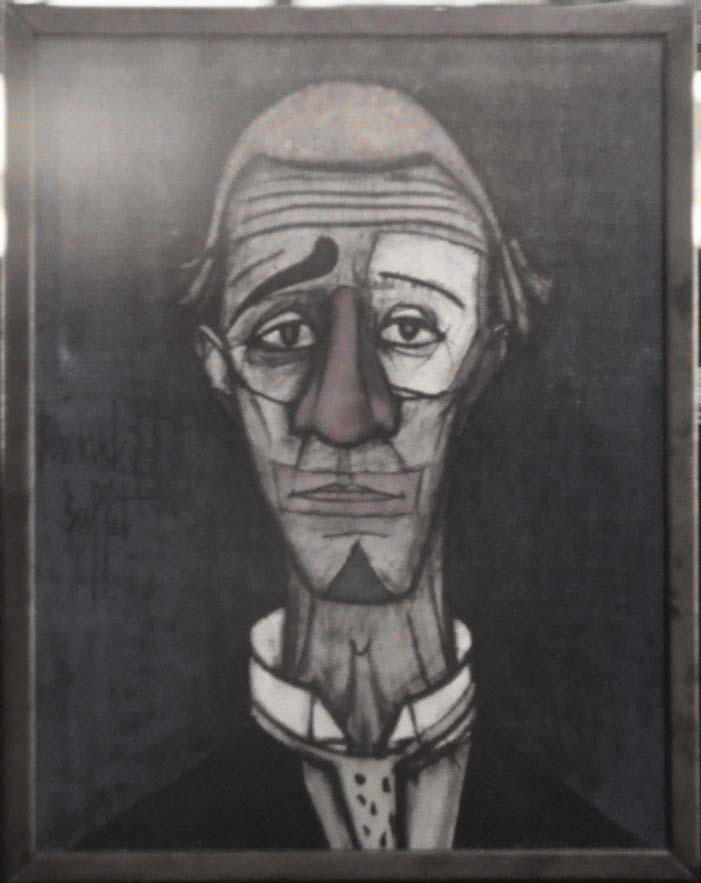
This got me thinking that if I were to do an extended exposure where the "cones" got to see the HM moonlight, I should see different colors (less blue). The picture below is the result of that experiment. Besides the apparent yellowing of the painting, the long exposure reveals a moon-glare that was invisible to my diurnal human eyes.


But obviously all this talk of the Moon "stealing colors" is metaphoric. Of course the colors are still there; we just can't see them because of the light. Well, actually no. If you can't see the colors, then they don't exist. Let me say that again: colors you don't see, don't exist.

"What kind of solipsistic nonsense is that?" you ask. Or perhaps you're asking "What is 'solipsistic'?"

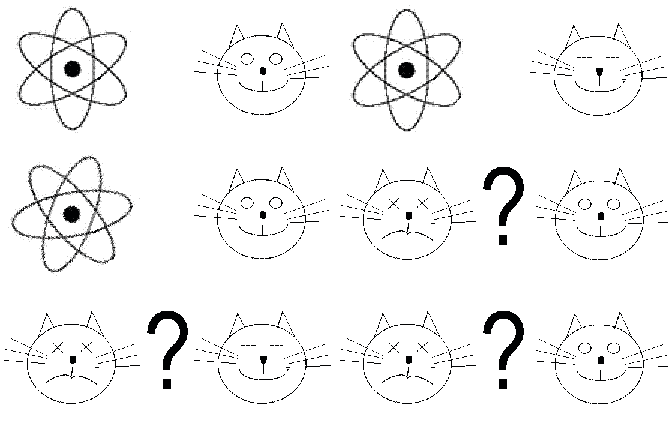
Solipsism is a group of varied philosophic tendencies that state that "the self" or "the mind" is the truest (or only true) reality: Cogito Ergo Sum. The most extreme case--metaphysical solipsism--claims that nothing outside of the mind is real. My introduction to solipsistic thinking was the paradox of Schrödinger's cat. This thought experiment is an extension of the observed and reproducible phenomenon from Quantum Mechanics that a quantum entity which can exist in one of two quantum states, exists in neither and exists in both (quantum superposition), until the moment it is observed. In the experiment, a cat in an opaque box is set to be killed if an atomic nucleus (with a 50% chance of decaying) decays. After the prescribed period, until someone looks into the box and observes, the cat is neither dead nor alive. It is in quantum superposition of being both dead and alive. In other words, the definite fate of the cat (which happened in the past) does not exist until it is realized by the mind of an observer. We can call this Quantum Solipsism.
Photobucket - Video and Image Hosting
Naturally, I rejected this and decided that solipsists were either clowns or lunatics. It would be years later (I was still in high school) before I learned about epistemological solipsism, so I shall come back to it later.

What started me on my road to giving solipsism a second look was my study of Neoplatonism, Middle Platonism and Plato. (That's right. I studied them in reverse order)

Neoplatonism is epitomized in the figure of Augustine of Hippo. Augustine believed that the sensible realm (the world we know) is transitory in nature, and that abiding realities could only be found in the intelligible realm, with God as its source. I really had trouble swallowing that circus act.

Middle Platonism is exemplified by Philo of Alexandria. Philo's Platonic reading of the Jewish scriptures, along with the transcendence of God and the abasing of the physical body, layed the groundwork for the future theological fondations of Christianity. Who are the crazies? I decided to check out the source.

Plato deserves much more attention than I can give him here, so forgive me if my summary is a bit curt. Plato seems to have also believed in the dichotomy of the sensible and intelligible. The intelligible is where the ideal exists and the sensible is but a poor imitation. This can be seen in his example of the chair.
He thought that everything had a sort of ideal form, like the idea of a chair, and then an actual chair was a sort of poor imitation of the ideal chair that exists only in your mind.

The trouble with this is that the mind (ie. - the brain) itself is fluid and not invariable. Today's ideal chair need not be tomorrow's, and mine (an EZ recliner) is surely not yours. Plato had it backwards: the "form" that exists in the mind is a contrived model based on incomplete sensory input. And this applies to all the "reality" that we know. As an example, let's re-examine the issue of color.

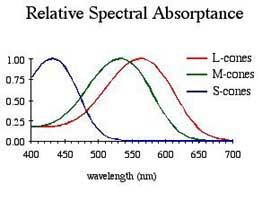
While it's true that some materials preferentially absorb or reflect certain wavelengths of electromagnetic energy, the "colors" that you and I are so familiar with are constructed in the brain. They do not exist outside of our awareness! Take a look at the retina (since rods and cones are types of neurons, I feel safe calling the retina part of the brain). Below is a graph showing wavelength sensitivity of the three types of cones in the human retina.


Each type of cone detects a different range of wavelengths. The peak of each curve represents the wavelength that gives the strongest signal for that cone type. Each type of cone reports only the intensity of the signal it receives. It cannot differentiate between a weak signal close to its "peak" wavelength and a strong signal further off on a tail of the curve. By having different cone types with overlapping sensitivities, the brain is able to put the information together and construct a color.

You may notice in the above graph two of the cone types (in the "red" region of the spectrum) are very close together. This means that our brains can more precisely discriminate between wavelengths in this neighborhood of the spectrum. To explain this, we need a quick review of evolutionary history. Most non-mammalian vertebrates--including birds--have four types of cones.

Some time ago, the ancestor of all mammals lost two of those cones. This is most likely because this animal was nocturnal and so wasn't well served by such fantastic color vision. Today, non-primate mammals only have two cone types. Which brings us to primates and their three. There are two ways this could have happened. If the "lost cones" were in fact just dormant, they could've been reactivated. This was not the case. Instead, a new cone type was created by a process called duplication. First, a copying error caused there to be an extra copy of the gene for "red" cone. Later, mutations caused the duplicate cone to become sensitive to somewhat different wavelengths. This is why their sensitivities are so close. Although there is a theory that this evolved as a way to better distinguish pinks--an indicator of fertility and emotion in primates. I'm all flush just thinking about it.

The thing to remember here is that the brain is not seeing wavelengths. It is getting sensory signals and constructing colors from them. A combination of different wavelengths of light that activated the cones in the same manner as a single pure wavelength would be seen as the exact same color. In the Scientific American article What Birds See, Tim Goldsmith tells of an experiment he did with birds . He trained birds to react to a certain wavelength of violet light and not others. He then demonstrated the the right blend of (92%) blue and (8%) UV light was indistinguishable from the training light to the birds. We would naturally be able to tell the difference because we don't have UV cones; we would see blue or violet. But for most of the spectrum, birds have a broader range of colors than we do.

It's not that the brain is being fooled into seeing the wrong color. Color is a creation of the brain. It's not out there in nature. It's only in the mind. When you take in all the leaves on the autumn trees, remember that those colors aren't actally there: they only exist in your head! When you're brought to joyful tears by the blushing pinks on your baby's cheeks, remember that those colors aren't actually there: they only exist in your head! And while you're marvelling at the magnificent works of art at the local museum, remember that those colors aren't actually there: they only exist in your head!

Everything that you know as reality is a construct of your brain. You cannot directly know the reality outside of your own awareness. That's not to say that reality is just an elaborate simulation, Occam's razor makes that quite remote. We just don't "know" any more about the outside reality other than it correlates well enough with our own realities that we can satisfactorily interact with it. This philosophy is otherwise known as epistemological solipsism.

Perhaps it's time for me to join the circus.

Tuesday, October 03, 2006

Remember ... walking in the sand.


My sister (the same one from the Katrina video) took this picture on her recent vacation in Georgia. I thought it was so cool; I just knew that I had to blog about it. Unfortunately, I know next to nothing about starfish--but that's never stopped me before.

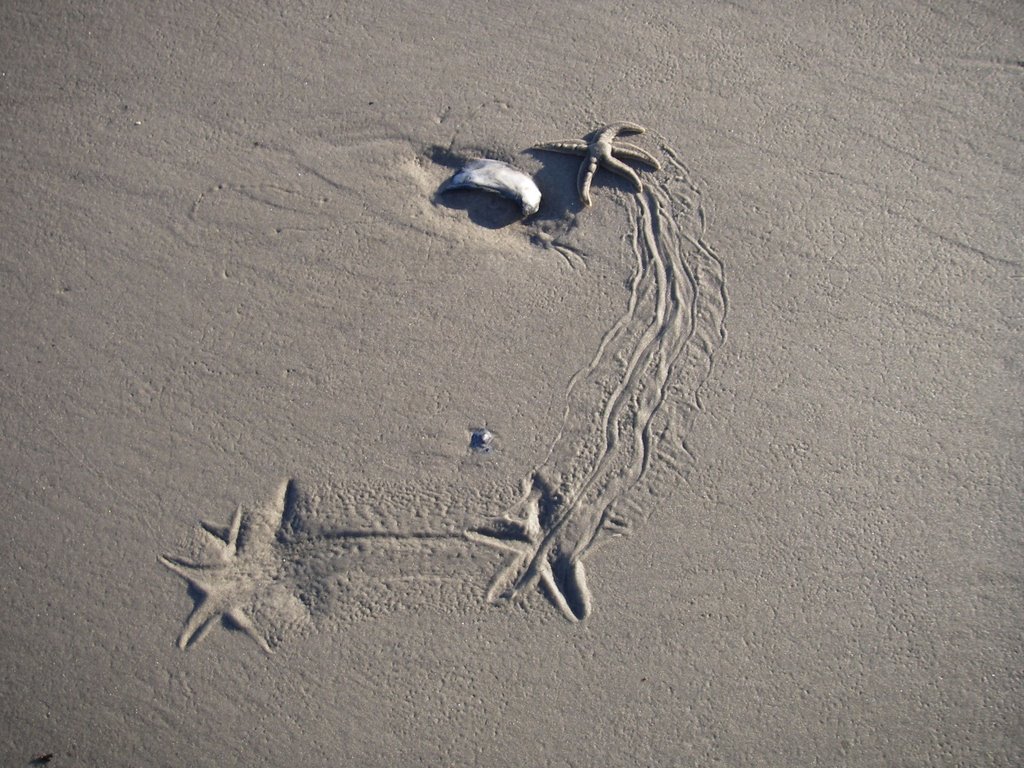
This is actually a really good picture. The composition and the lighting are perfect. And you can make out the starfish's tracks quite well. Looking at the picture, the ocean is off to the upper left. So the starfish started to briefly head off away from the water, then he banged-u and headed on home. Shortly after the picture was taken, my sister picked him up and gently tossed him into the ocean (which was quite a ways away and still receding).

The next thing that pops out at you about the picture is that the starfish left exactly three whole body prints in the sand. Was he making sand angels? I'm not sure what he was "thinking," but these were surely spots where he stopped and began to sink in due to the soft, wet sand. These couldn't have been caused by waves crashing in around him, as these would've erased the record of his past travels. By that same token, the first whole body print must represent where our friend was resting when the tide first receded. Also, the possiblity that he didn't slow down but hit some unusually soft patches of sand seems unlikely to me. There's nothing in the sand around those three spots to indicate that such soft spots are there. These were almost certainly pit-stops.

The initial impression is the shallowest of the three, and the second print--which lies so close to the first as to overlap it--is the deepest. My guess is that shortly after the tide began to recede, our starfish friend moved to a more "comfortable" position in the sand and stayed there a while longer. Then he began his trek.

The third impression is the most interesting to me. This represents his turn back towards the ocean. It would be too easy to anthropomorphise our spineless, pentapodal friend and say that this was where he realized that he was heading in the wrong direction and stopped to get his bearings straight. He pulled the beach map out of his glovebox, all the while his wife was nagging him about how "I told you that wasn't the ocean exit!" In truth, I don't know a thing about how starfish navigate. I did some looking on the internets (including wikipedia) and came up empty. I even asked my sister what she thought the starfish was thinking. Her unhelpful reply was "Damn! I was right there with him and I totally forgot to ask him." That leaves me no choice but to stick with my lost traveler metaphor.

The other interesting thing about that third impression is the difference in the track marks leading to it and away from it. In the tracks leading away from the third impression, you can clearly see where the hind appendages were dragged through the sand. The tracks to the impression seem more evenly dispersed. It's like the difference between tracks left by a sled (with rails) and a toboggan. My extemporaneous expertise tells me there are two possible explanations for this. Perhaps he was in a bigger rush after changing direction (this fits in nicely with my lost traveler metaphor). Or maybe it was just the difference between moving with or against the grain (in the sand, the "grain" would be created by the receding tide).

All this made me curious as to how starfish actually do move. Here's a good explanation from Jonathan Dale's website.

The underside of the starfish is covered with hundreds of tube feet, which it uses for walking around, for attaching tightly to rocks, and for holding on to prey. To move, each tube foot swings like a leg, lifting up and swinging forward, then planting itself on the ground and pushing back. At the tip of each tube foot (in most species) is a suction cup. These aren't used when walking on level ground, but can be used when walking up sheer surfaces.


Here's a nice close-up photo of the tube feet from Wikipedia:


Here's a cool time-lapse video of some starfish moving around an aquarium from Jan Ellenberg's site.


And finally, take a look at this "creepy" YouTube video of a brittle star walking along the bottom of a tank. It actually moves its limbs like an octopus. Unfortunately, it has three few limbs to get PZ all excited.


My sister tells me that she has entered the photograph in a "nature photo" contest on the internets. I sure hope she wins!

UPDATE: The picture is now up on National Geographic! Hurray!!!