Congratulations to P.Z. Myers on winning the meaningless weblog award for best science blog. I have to confess that I was a bit torn. Pharyngula is the first blog I check every day. However, I've been reading Phil since the days of his old Yahoo listserve.
Anyhoo, as a tribute to the winner, I bring you a new species of giant squid. Here's a description of the "far red" camera and lure that was used to snag the shots.
The Eye-in-the-Sea (EITS) was designed to address these questions. The autonomous EITS is a programmable, battery-powered camera and recording system that can be placed on the sea floor and left for 24 to 48 hours to observe the animal life in the dark depths with as little disturbance as possible. It uses far red light illumination that is invisible to most deep-sea inhabitants and an innovative electronic lure that imitates the bioluminescent burglar alarm display of a common deep-sea jellyfish.
The very first time this lure was used it attracted a large squid that is so new to science it can not be placed in any known family.
Just follow this link to see the video of the depth dwelling cephalopod. (via New York Times)
Today is the tenth anniversary of Carl Sagan's demise. I have to admit that I missed Cosmos when it first came out. But I was intrigued by all the Johnny Carson jokes and the "billions and billions" schticks, so when the series was replayed I just had to watch it. I was blown away.
About a year later, I went to visit a friend who was attending Cornell University. The whole way there, all I could think about was "I hope I bump into Carl Sagan." Alas, I did not, but I did learn that Ithica is gorges.
Several years later, I got into reading popular science books and essays. Dawkins and Gould turned me on to evolutionary biology, but I also read Druyan and Sagan. The man was surely one of the premire poets of science. (I was a little disappointed by the movie Contact, although it did have its moments.)
Sorry for the lame post, but it's late and I want to get something up before the end of the day. There are some really nice tributes over at Joel's humanistic blog as part of the Carl Sagan blog-a-thon. Check them out.
And so this post won't be a complete wash, I present Carl Sagan and the Cosmic Calendar. Thank Google for embeded video.
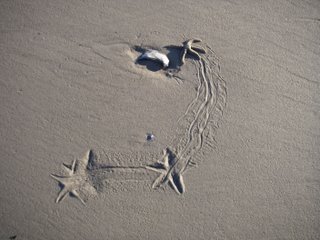
Two and a half months ago I wrote a post about a picture my sister took of a starfish on the beach. In that post I encouraged her to submit the picture to every photo contest she could find. She did. And now her picture is online at National Geographic. Awesome!
Scientists and judges have quite different ways of resolving issues. Courts set up a dichotomy of litigants, with each side getting equal weight (at least fair courts work that way). Each side gets to argue its case before the court (judge and/or jury of peers), and the side with the more persuasive argument wins. Each side gets to present evidence and question the opponent’s evidence, while the judge decides what evidence is admissible.
Science tries to accrue knowledge and reach the truth through research. Scientists look at the evidence, make hypotheses, and then test the hypotheses to see how valid they are. Their conclusions are then published in peer-reviewed journals where other scientists may scrutinize the work and gauge its validity. A consensus among scientists determines what is the accepted "truth." The journal’s editors decide which papers are worthy of publishing.
They sound similar, and in many regards they are, but there are a few crucial differences.
Science is an “open source” discipline. Scientists put all of their research and results out there for all to see and evaluate—including results that contradict their findings. It is considered a scandal when it is revealed that a scientist hid results from his peers and the public. (Is it a coincidence that most of the achievements that critics of science point to as being evil—atomic weapons, Nazi eugenics, etc.—were the result of science being performed behind closed doors? Just a thought.) In most court cases, the competing sides are under no obligation to disclose certain damning evidence to each other. In fact, attorney-client privilege often forbids it. This stems from the different mentality that the “truth” (verdict) is achieved by dispute resolution.
Judges are generally the preeminent experts in matters of law. This is ideal for complicated legal disputes. The "jury of peers" is a group of citizens who need only have an understanding of the law. This works well for most simple legal issues. "Scientific peers" are experts in the field of study in question. This is an absolute necessity for matters of scientific inquiry. Two scientists arguing dissenting theories can sound like they are speaking Greek (literally) to a layperson or even scientists outside of their field of expertise.
What happens when the two meet? This is a very sticky situation. Scientific disputes should be fought in the arena of science. Judges and juries are not qualified to evaluate an issue for which scientists have yet to reach a consensus. This sometimes happens, though. Even worse, scientific disputes in which a consensus has already been reached are oftentimes brought into the courtroom to be argued anew. Here they are subject to different rules, and the side with the better rhetoric can win the day.
Clearly, reforms are needed for when science meets law. I am however optimistic. The recent decision in the Dover, PA “monkey trial” and the reversal of the silicone implant ban give me hope for the future. Perhaps in ten years the courts will have institutionalized an organic system that is true to science for dealing with “science meets law” cases.
For this reason, our legal system, despite its problems, is a shining beacon of scientific enlightenment compared to many. This brings me to Libya.
A while back, I wrote a couple of posts about the Tripoli 6. These are the five Bulgarian nurses and Palestinian doctor who had been falsely accused of intentionally infecting Libyan children with HIV as part of a nefarious CIA/Mossad plot. Scientists stepped in and looked at the evidence. Their verdict was that the children were all infected (probably by the reuse of needles) prior to the arrival of the medics. They are clearly innocent! Then the Libyan court system stepped in and came to its verdict: guilty! Sentence: death!
Crowds cheered outside when the verdict was announced. I can’t really blame them so much (although I would never cheer anyone’s death sentence). It is unlikely that they knew about the scientific evidence, and quite likely that they wouldn't understand it even if they did know about it. It is truly sad and outrageous.
Last week Mickey Grant, maker of the documentary Injection about the plight of the medics, made a last ditch call to try to rally more worldwide awareness about this travesty. I really wish that I knew some real journalists who I could have pressured to cover the story. Alas, all I could do was sit back, watch the verdict, and feel impotent about the whole thing. This makes me sick to my stomach.
I still have hope, but I can’t say it’s realistic.
Last Friday, Point of Inquiry had an interview with Susan Blackmore. I found it altogether fascinating. It is well worth the listen. She talked about the out of body experience she had when in college. I have a pet theory as to what brought on her experience, but you'll have to listen to the podcast to find out what it is. She talked about how that experience led her down the path that would bring to where she is today. She also explained why she practices Zen Buddhism. But what really captivated me was when she spoke about free will.
I thought that I would be somewhat skeptical of her views. But after listening to her, I think our differences on the subject came down to what the definition of "free will" was. After all, depending on your approach, the question "What is free will?" can be just as difficult if not more than "Is there free will?"
So what is free will? You can't say that it's "not being affected by the outside world;" everything that interacts with its environment is affected by it. A reasonable definition then, would be "not being controlled from the outside." This tends to fit well with the basic idea of free will. It can get a little dicey when you go to draw the line for where "affected" ends and "controlled" begins. Let me give an example to illustrate more or less where I see that line. A mannequin is controlled by its puppeteer; it has no free will. But if the puppet is an autonomous robot, an autonomous robot that can rewrite its own programming based on experience, an autonomous robot whose decisions are complex and variable, then I would say that puppet has free will.
I would also say that autonomous robot is deterministic and probably doesn't have conscienceness--at least not in the way we think of it. This of course means that my definition will not be universally accepted, as I've heard the concept of free will tied to conscienceness and incompatible with determinism. I do not agree with those assessments.
I see no conflict between determinism and my definition of free will. A decision is a process; every process can be broken down into simpler steps. Once you get down to the simplest steps, they must fall into one of three (and only three) categories. Each step is either determined (cause leads to effect), random (effect not dictated by cause), or magic (undefined: almost certainly doesn't exist). This holds true whether you are talking about the base circuitry of wires or neurons, or the "higher software" that does the "thinking." In that sense, we humans are no different than the autonomous robot, and so if we can be said to have free will, then so can the robot.
Another thing I hear thrown about is statements to the effect of "the randomness of quantum mechanics liberates us from the bonds of determinism and allows us to have free will." That is utter nonsense. (quick note: The "randomness" of quantum mechanics is not haphazard; it follows established wave equations, it's experiments are reproducible, and the behavior is predicted by theory.) Besides, if one believes that strict determinism robs you of free will, how in the hell is random behavior any better? Hmm, let me think ... oh yeah, it's not! And furthermore, there's nothing stopping us from adding randomness to our "auto puppet." This puppet--this machine--must have free will just like we do. That only leaves magic, but magic doesn't exist. If your definition of free will requires magic, then free will, as so defined, does not exist.
This brings us to the issue of conscienceness. Nobody really knows what it is, therefore we can't really know whether out auto puppet has some form of it or not. There are behavioral tests out there that some people use to determine degrees of conscienceness (mirror test, turing test). But these behavioral tests leave many of us unsatisfied. We must rely on empathy. We watch a behavior for signs of conscienceness, but we can't know if it's really there. For example, the turing test is a test to see if an A.I. can fool a human into thinking that he or she is talking to another human. In that case, the conscienceness we would percieve in that A.I. (that passed the turing test) would be an illusion--or would it? And is our own conscienceness just an illusion? (Rene: That's not as outlandish as it may sound.)
Many see conscienceness as something ethereal; I think it is most certainly not. I see conscienceness as a web of sensations created by the brain. Take this letter written to NewScientist regarding this article.
The article on confabulation repeats a logical fallacy (7 October, p 32). "The idea that we have conscious free will may be an illusion," writes Helen Phillips, because a 1985 experiment "suggested that a signal to move a finger appears in the brain several hundred milliseconds before someone consciously decides to move that finger".
This is silly. The process of making a "conscious decision" to act is obviously not a single event. Factors for and against action must be weighed up, inhibitions must be overcome, environmental constraints must be checked, the muscular signals must be planned so that the action is properly coordinated, and so forth. That fact that somewhere along this complex pathway a signal can be measured indicating movement of a finger is imminent is quite unsurprising. The fallacy lies in inferring that the sensation of "conscious decision" that appears later on is thus illusory or "faked".
We sense all things in a delayed fashion. Our conscious recognition of a flash of light, for example, occurs well after the light actually flashes. Why should the sensation of our own consciousness be any different?
And if we have no free will, then why even bother producing the fake sensation of consciousness after the fact? If we, the conscious entity, could not exert any free will over what our body will do in the future, then our body would presumably conserve energy by simply turning out the lights.
With the exception of his last paragraph, this pretty much describes my view. We are essentially autonomous robots with sensations--including the sensation of our own thoughts.
After listening to the Susan Blackmore interview, though, I am not so confident in that view (or more specifically, my definition of free will) . As reasonable as my definition of free will seems to me, that's not what the vast majority of people mean when the say "free will." They think of an independent agent: an invisible homunculus inside your head. When most people think of free will, they think of the sensation of thought actually controlling that thought. In other words for most people, free will means magic. If I'm to accept the most common definition of free will, then I must agree with Blackmore and positively aver that there is no such thing as free will.
UPDATE: Between the time I started writing this post and when I finished, Dennis Overbye wrote this article in the New York Times about free will. It is quite interesting; he gets into the philosophies of Danial Dennet, Alan Turing and Kurt Gödel. Good stuff!
I've been carless for six years now; I've been a bicycle advocate for four of those years. As a long time bicycle commuter, I am highly concerned about safety. Two lemmas that are drilled into us and that we parrot back to novices are: 1. Always wear a helmet. 2. Obey all traffic laws.
What I am about to say will probably make heads spin if any of my friends over at the bike coalition should stumble upon this post. I don't always practice what I preach. In fact, I think I'm being safer when I don't.
To be clear, I do wear a helmet most of the time. It's demonstrably helpful for most spills a cyclist will take. But does that mean that you're safer when wearing one? Not according to Dr. Ian Walker.
Dr. Walker performed a study where he rode a bicycle fitted with an ultrasonic distance sensor both with and without a helmet.
Dr Walker, who was struck by a bus and a truck in the course of the experiment, spent half the time wearing a cycle helmet and half the time bare-headed. He was wearing the helmet both times he was struck.
He found that drivers were as much as twice as likely to get particularly close to the bicycle when he was wearing the helmet.
...
“By leaving the cyclist less room, drivers reduce the safety margin that cyclists need to deal with obstacles in the road, such as drain covers and potholes, as well as the margin for error in their own judgements.
“We know helmets are useful in low-speed falls, and so definitely good for children, but whether they offer any real protection to somebody struck by a car is very controversial.
“Either way, this study suggests wearing a helmet might make a collision more likely in the first place.”
But why would this be so?
Dr Walker suggests the reason drivers give less room to cyclists wearing helmets is down to how cyclists are perceived as a group.
“We know from research that many drivers see cyclists as a separate subculture, to which they don’t belong,” said Dr Walker.
“As a result they hold stereotyped ideas about cyclists, often judging all riders by the yardstick of the lycra-clad street-warrior.
“This may lead drivers to believe cyclists with helmets are more serious, experienced and predictable than those without.
“The idea that helmeted cyclists are more experienced and less likely to do something unexpected would explain why drivers leave less space when passing.
That actually makes some sense. I know that when I ride on the public bike (and multi-purpose) paths, I always give extra space to unhelmeted riders (or riders with cellphones, ipods, etc.). Although I can usually gauge a cyclist's bike handling skills by simply watching them ride for a second or two.
I'm still a believer in helmets most of the time, but if I'm just making a quick trip to the store, I'll generally pass on the foam hat. My own philosophy is that I always wear a helmet when I'm donning lycra (~90+% of my riding). If I'm out of uniform, the helmet is optional. This fits in well with Dr. Walker's findings. His conclusion is quite apt.
“The best answer is for different types of road user to understand each other better.
“Most adult cyclists know what it is like to drive a car, but relatively few motorists ride bicycles in traffic, and so don’t know the issues cyclists face.
“There should definitely be more information on the needs of other road users when people learn to drive, and practical experience would be even better.
“When people try cycling, they nearly always say it changes the way they treat other road users when they get back in their cars.”
Now what about obeying traffic laws? According to your driver's manual, a bicycle on the road is a vehicle and must obey all the same laws that automobiles follow. I'm sorry but that's just ridiculous. (coalition heads spinning) First, that statement isn't technically true: all motorists must be licensed. Second, the vast majority of those laws were not written with bicycles in mind. Some of the traffic rules seem absolutely preposterous for a vehicle that can travel in the shoulder. Others make no sense for a vehicle that weighs under 200 pounds.
I generally use my own judgement as to when to obey and when not to. I think that I'm actually riding safer when I use my acumen rather than following motorist's rules. I realize that that's just based on gut feeling and anecdotes, but they come from at least ten years experience riding almost every day. And Coturnix thinks that even cars are being safer when negotiating traffic rather than acting like automatons.
Seed Magazine has an article by Linda Baker about how some cities (like Portland--rated the best cycling city in the USA) are even taking some of those rules away in order to make the roads safer.
Portland's so-called "festival street," which opened two months ago, is one of a small but growing number of projects in the United States that seek to reclaim streets used by cars as public places for people, too. The strategy is to blur the boundary between pedestrians and automobiles by removing sidewalks and traffic devices, and to create a seamless multi-purpose urban space.
Combining traffic engineering, urban planning and behavioral psychology, the projects are inspired by a provocative new European street design trend known as "psychological traffic calming," or "shared space." Upending conventional wisdom, advocates of this approach argue that removing road signs, sidewalks, and traffic lights actually slows cars and is safer for pedestrians. Without any clear right-of-way, so the logic goes, motorists are forced to slow down to safer speeds, make eye contact with pedestrians, cyclists and other drivers, and decide among themselves when it is safe to proceed.
Now I'm not advocating riding like a bicycle messenger--those guys are crazy! But seriously, messengers are probably some of the best cyclists out on the road. They are experts at negotiating city traffic. (Another myth is that bicycling in the big city is more dangerous than out in the suburbs. Quite the contrary is true. There are several reasons for this, but the most important is that city motorists expect to see bikes. A suburban motorist who isn't expecting bikes, can look right at a cyclist and not "see" him. Then after the accident say "He came out of nowhere!" City drivers know cyclists are entitled to share the road. In all my years of city cycling, I've never had a motorist scream "Get off the fucking road!"--the same cannot be said for the suburbs.) They (messengers) use their judgement just like I do, albeit with different lines they don't cross. When you see a messenger riding like he's oblivious to all the traffic around him, remember that he sees more than you. For example, while an automobile driver is contained inside a box at least two meters behind the front of the vehicle, a cyclist is only a foot or two from the front of his vehicle and out in the open with full use to his peripheral vision.
In the following video of a 2004 New York City bike messenger race, you get to see them in action. The first time I saw this, I thought they were all lunatics. But the more I watch it, the more I recognize how skilled they are. For example, while it may seem that they are recklessly blowing through red lights, if you pay careful attention, you'll see that they are following each others cues as well as running interference for each other. And remember that the helmet-cam doesn't have the same perspective and peripheral vision that the cyclist does. In fact, the most dangerous thing I saw was the guy coming off the bridge without brakes and with his feet off the pedals. (I also wouldn't recomend getting stoned right before you go riding.)
Since it's 23 minutes long, it took me a while to get around to listening to this recording. (via MarkCC) But when I did, I was amazed. It's well worth the listen, but at the same time it's infuriatingly frustrating. I found myself banging my head against the wall along with the caller.
Quick synopsis: Guy is travelling to Canada. Before leaving he calls Verizon wireless to check what the rate will be. He is quoted 0.002¢ per kilobyte. Just to be sure he asks the rep to repeat that it is 0.002 cents and not 0.002 dollars and to put it in writing. When his bill arrives, he finds he has been charged $0.002 per kilobyte. The recording is of what happens when he calls Verizon to complain.
I've noticed that many other bloggers do something special on Fridays, so I'll be giving it a shot too. I'm going to try to do a madness themed post every Friday. I figure that's a broad enough category that even if I'm suffering from severe blogger's block, I can always just link to something Fred Phelps or Pat Robertson said.
So for my inaugural Friday Madness post, take it away Freddy!
I find it despicable when corporations use endearing characters in order to market dangerous and/or addictive products directly to our youths.
Joe Camel was certainly a case of this. For one thing, he always reminded me of another certain character that I was fond of in my youth.
Then there's the thing with those internal memos. It is clearly apparent that they were using the character to entice teens into using and getting hooked on their product.
But what about Santa Claus? Is he also a nefarious marketing tool? I believe that he's certainly a marketing tool—something where evangelicals and I might find common ground. But the Santa Claus demographic is not the same as the Joe Camel demographic. Santa Claus marketers target the "Mommy, mommy! I want ..." generation. Joe Camel went after kids who bought their own paraphernalia. That's why I probably wouldn't be as outraged if RJR came out with Kris Kringle Smokes. So what about Santa on beer bottles? It seems the State of Maine has decided that this bottle can't be on the shelves.
But the state says it's within its rights. The label with Santa might appeal to children, said Maine State Police Lt. Patrick Fleming. The other two labels are considered inappropriate because they show bare-breasted women.
"We stand by our decision and at some point it'll go through the court system and somebody will make the decision on whether we are right or wrong," he said.
So let's see. A mother is in the supermarket with her six year old and ventures into the beverage aisle to buy some egg-nog. All of a sudden, the child spots the bottle of Santa's Butt beer and starts yelling "Mommy, mommy! It's Santa!" The youth of Maine has now been corrupted.
But those other two labels are another matter altogether.
Maine also denied label applications for Les Sans Culottes, a French ale, and Rose de Gambrinus, a Belgian fruit beer.
Les Sans Culottes' label is illustrated with detail from Eugene Delacroix's 1830 painting "Liberty Leading the People," which hangs in the Louvre and once appeared on the 100-franc bill. Rose de Gambrinus shows a bare-breasted woman in a watercolor painting commissioned by the brewery.
In a letter to Shelton Brothers, the state denied the applications for the labels because they contained "undignified or improper illustration."
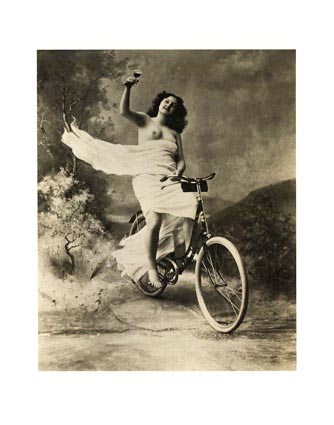
Bare breasted women on beer bottles?? It's sacreligious! Imagine the audacity. I guess my idea for a wine label will never fly in Maine.
"Queen of the Wheel," copyrighted in 1897 by the Rose Studio of Princeton, NJ.
It all started back in September when Discovery Institute hack Casey Luskin attacked science blogger Chris Mooney, author of The Republican War on Science. Then a couple of weeks ago he went after science blogger Carl Zimmer, the fantastic writer whose work appears in the New York Times. Among the inanities he spewed was a defense of imperfection by comparing ID to a Ford Pinto.
"Was the Ford Pinto, with all its imperfections revealed in crash tests, not designed?"
This statement goes against the whole design argument; Is God a poor engineer who didn't heed Murphy's Law?
As ridiculous as that analogy is, Karmen at Chaotic Utopia glommed on to a doozy that all the other science bloggers had missed.
The article called evolution a "simple" process. In our experience, does a "simple" process generate the type of vast complexity found throughout biology?
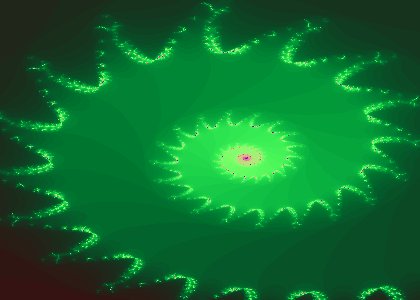
I can see how this must've really irked Karmen since one of her regular features is Friday Fractals. You see, fractals are complex patterns generated from simple algorithms.
I'm afraid my fractals aren't quite as good as Karmen's since I made mine with the free software GIMP. The point remains that a fractal is a perfect example of a "complex design" that's generated by a few simple instructions.
The fun continues. Mark Chu-Carroll of Good Math, Bad Math expatiated upon the theme by bringing cellular automata (CA) into the mix.
For the simplest example of this, line up a bunch of little tiny machines in a row. Each machine has an LED on top. The LED can be either on, or off. Once every second, all of the CAs simultaneously look at their neighbors to the left and to the right, and decide whether to turn their LED on or off based on whether their neighbors lights are on or off. Here's a table describing one possible set of rules for the decision about whether to turn the LED on or off.
Current State
Left Neighbor
Right Neighbor
New State
On
On
On
Off
On
On
Off
On
On
Off
On
On
On
Off
Off
On
Off
On
On
On
Off
On
Off
Off
Off
Off
On
On
Off
Off
Off
Off
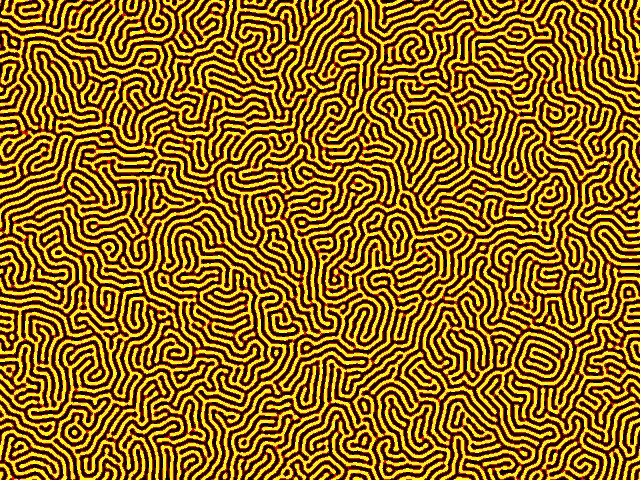
There you have two examples of "complex designs" spawned by "simple processes." Before I bring up a third, I should mention that MarkCC made a point that the above CA is turing complete. Nice segue since the next image will be a Turing Pattern. This "design" is so named because it derives from the principles layed out in the great mathematician Alan Turing's 1952 paper The Chemical Basis of Morphogenesis. In it, Turing demonstrates how "complex" natural patterns such as a leopard's stripes (or any embryological development) can be generated from simple chemical interactions. This ScienceDaily article describes it thus:
Based on purely theoretical considerations, Turing proposed a reaction and diffusion mechanism between two chemical substances. Using mathematics, he proved that such a simple system could produce a multitude of patterns. If one substance, the activator, produces itself and an inhibitor, while the inhibitor breaks down or inhibits the activator, a spontaneous distribution pattern of substances in the form of stripes and patches can be created. An essential requirement for this is that the inhibitor can be distributed faster through diffusion than the activator, thereby stabilizing the irregular distribution. This kind of dynamic could determine the arrangement of periodic body structures and the pattern of fur markings.
The kicker is that the above mentioned ScienceDaily article is entitled Control Mechanism For Biological Pattern Formation Decoded and it's about how biologists and mathematicians in Freiburg—hence the 'German flag' color scheme on my Turing Pattern—have found an example in nature of just what Turing predicted.
Biologists from the Max Planck Institute of Immunobiology in Freiburg, in collaboration with theoretical physicists and mathematicians at the University of Freiburg, have for the first time supplied experimental proof of the Turing hypothesis of pattern formation. They succeeded in identifying substances which determine the distribution of hair follicles in mice. Taking a system biological approach, which linked experimental results with mathematical models and computer simulations, they were able to show that proteins in the WNT and DKK family play a crucial role in controlling the spatial arrangement of hair follicles and satisfy the theoretical requirements of the Turing hypothesis of pattern formation. In accordance with the predictions of the mathematical model, the density and arrangement of the hair follicles change with increased or reduced expression of the WNT and DKK proteins.
There you go, Mr. Luskin: an example from natural biology of a simple process generating vast complexity. To your Woo, I say Schwiiing!
On my return trip from Thanksgiving vacation, I had the pleasure of taking DC's Metro to Union Station. At some point early in the trip, four college-aged girls boarded the train. I naturally noticed this because they were all hotties (two of them were super-hotties). I got a bit curious when I noticed that they formed two pairs that were uneasily close. Could it be??
Nah, probably just my imagination; besides, it's rude to stare. So I went back to reading my magazine. But they weren't about to let me do that--they were being noisy. And every time I looked up, my suspicions were bolstered. That's when I saw the blatant Public Display of Affection: "All right, lesbians!" Not staring was more difficult now as was holding back my excitement. At the next stop they got off the Metro and my ride got mundane again.
A famous comedienne (sorry I can't remember which one) once commented on how she didn't understand men's obsessions with lesbians. After all, lesbianism is the ultimate dismissal of masculinity; it should logically be threatening to men. But it's not. Why not?
That's actually a pretty interesting question. In a rational world, men wouldn't get turned on by girl on girl action, but believe me, they do. For a long time, my explanation for this derived from my rudimentary knowledge of evolutionary psychology. Males are out to spread their seed, so they see a lesbian coupling as an opportunity to jump in and procreate more. Females, on the other hand, want a man who will help rear her children, so homosexuals are a bad investment.
This hypothesis started to unravel for me, though. It seemed that every woman I brought the subject up with, was not only cool with having gay male companions, but would jump at the opportunity to go party at a gay bar. I realize that this is anecdotal and that their motives might not in fact be voyeuristic (but their mannerisms somehow gave me that deja-vu feeling of "All right, lesbians!"). This was seriously undermining my EP hypothesis; I needed something new.
On the Amtrak train back to Philly (with the "METRO incident" still fresh on my mind) I read an article about mirror neurons. Everything just clicked together and now I had my new pet hypothesis.
A mirror neuron is a neuron which fires both when an animal performs an action and when the animal observes the same action performed by another (especially conspecific) animal. Thus, the neuron "mirrors" the behavior of another animal, as though the observer were itself performing the action. These neurons have been observed in primates, including humans, and in some birds.
Mirror neurons were first discovered by Giacomo Rizzolatti and other Italian neuroscientists. They were first discovered in monkeys whose brains were wired up with electrodes; they were later confirmed to exist in humans (recent research suggests that humans are particularly well-endowed with mirror neurons). The interesting thing about mirror neurons is that they seem to be sensitive to intent. For example, in the monkey experiments, when the simian watched a hand pick up an object, the same neurons fired as when the monkey itself picked up that object; but when it watched a hand pretend to pick up a non-existent object, the neurons didn't fire. And this pattern was observed even when the monkey's view was obscured by a screen. In other words, when the monkey knew there was an object behind the screen, its (mirror) neurons fired when it watched the hand go behind the screen to pick up the object; but they failed to fire when the monkey knew there was nothing behind the screen.
Itstands to reason that we have mirror neurons for kissing. These same neurons that fire when we kiss someone should also fire when we watch others kissing someone. And I would expect that if you're the kind of person who is aroused by kissing (I'll go ahead and aver that that's the predominance of humanity), watching others kiss should trigger some of those same feelings.
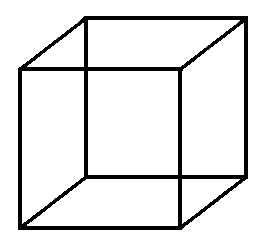
But how does this explain men's particular fascination with lesbians? My answer is "the necker cube effect." The Necker Cube is an optical illusion. It consists of 12 interconnected lines drawn on a flat surface. The human brain wants to see it in three dimensions and so adds depth to it. But it doesn't end there; there are two possible 3D configurations: with the lower square up front and with the upper square up front. Since both are possible, and since the brain can't "see" them simultaneously, it flips back and forth. I usually see the lower square up front first, then it starts to flip-flop back and forth.
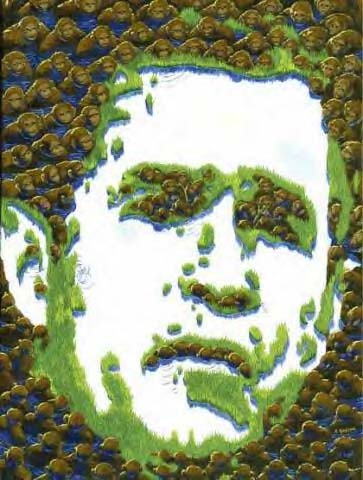
Perhaps a more appropriate optical illusion is the "two ladies or one" illusion (are the two ladies about to kiss?) ;-)
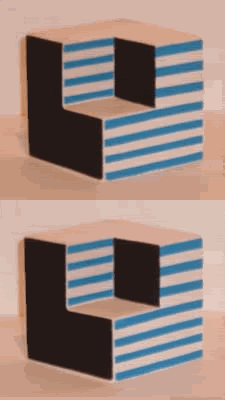
One of my favorites, though, is the Lyondell cube. Below is my foam Lyondell cube. It is just a cube with a smaller cube cut out of one of its corners. But if you look at it from the right angle, the missing corner becomes a solid cube budding out from the main cube--then it reverts back to a hole. The effect is quite eerie when you hold the cube and wiggle and wobble it in your hand. Just freaky!
My hypothesis is that when watching lesbians kiss, men's kissing mirror neurons are activated, but then, just like the necker cube, they start to flip back and forth between which girl is activating the mirror neurons (and this adds extra excitement).
Since I came up with this hypothesis on the fly, I realize that A) It may be total bunk, and/or B) Someone else may have already come up with the same idea.
However I find it intriguing enough to just go with it.
On that note I'll leave you with a short YouTube video (I should probably insert an "adult content" warning here, but if you're the type who is offended by to consenting adults kissing, then you're probably also offended by my posts on religion. Which means that this weblog is not for you.)
And if my hypothesis is correct, I certainly wouldn't want to slight any straight females or gay males who may stumble upon this post.
I'm a bit late doing this post (although I did leave a comment when it was fresh), but congratulations on the engagement of two excellent science bloggers (physics bloggers, no less).
Jennifer Ouellette of Cocktail Party Physics is one of my favorite bloggers because she's such a pleasure to read (I might just have to buy The Physics of BuffyVerse) and it doesn't hurt that she has me on her blogroll (Of course I still don't have a blogroll myself, but when I get around to it, she'll be there).
Sean Carroll of Cosmic Variance is also an awesome physics blogger. I must confess that I'm not as big a reader of CV as I am of CPP. (although how can you not love photographic evidence of Russell's teapot?)
Love found on the internet between two sciencephiles. What could be better?
There's a meme going around the net (via) and there's an experiment seeing how fast it spreads. It goes thus: 1. Please link to this post by Acephalous (as I'm doing) 2. Ask your readers to do the same (if you haven't already, remember, it's for SCIENCE!) 3. Ping Technorati. (and spell it correctly)
I am always willing to do my part for science. Be on the lookout for my upcoming experiment here I'll need my readers to send me money ;-)
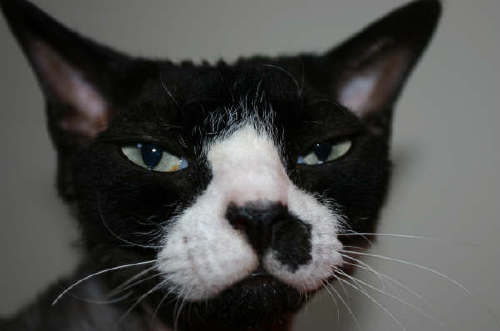
Yesterday I came accross an intersting site while browsing the internets. It's a website called Cats That Look Like Hitler. I guess you can find anything on the internet. My favorite Kitler is Frodo.
Although I must tip my hat to Charlie--the costume had me rolling on the floor.
What's next? Dogs that look like Saddam? Gerbils that look like Kim Jong Il? Personally, I'll just stick to the world leader/animal resemblence that is at the forefront right now.