Monday, April 06, 2009

Circus of the Spineless 37 is now up!


Go check it out at GrrlScientist! There are some really great posts over there (and there's even one from your's truly). There's fantastic photo essays, cool videos, and informative educational pieces. Go there now!

Wednesday, April 01, 2009

Derek the Abstinence Clown

I really wish that this was an April Fools joke. Well, it's a joke alright, but an unintentional one. You have to see to believe.


(via, and)

Friday, March 20, 2009

Today's APOD: the Ī ortara

To celebrate the vernal equinox, APOD has a picture of the Portara--the entrance of the ancient Temple of Apollo on the island of Naxos--take at sunset during last June's summer solstice. However, when I look at the picture, I see an image which would have been very appropriate only four days ago(Pi Day). That's right, I see the silhuette of a Capital letter pi against a setting circle. I'm such a geek!

Thursday, March 19, 2009

Volcano!

Amateur exorcist and potential 2012 Republican presidential candidate Bobby Jindal thinks that volcano monitoring is a waste of money. I wonder if he's ever seen an underwater volcano eruption up close?


That was pretty amazing! Now just for fun, here's some Jimmy Buffet.

Sunday, March 15, 2009

Video Sunday

Yesterday was Pi Day (3/14). To celebtrate, I ate some slices of pizza pie. Also, here is an explanation of how to figure out the area of a circle much as the ancient Greeks did. You'll notice that the principle is the same that's used in Calculus to measure the area under a curve. In fact, the Greeks used the same general method to calculate all sorts of areas and volumes. Of course it would be about a couple millenia before the invention of the Calculus where we could calculate the area under any defined curve.


Yesterday was also Albert Einstein's birthday. Here's an audio recording of the man himself explaining the significance of his most famous equation.


And finally, just for fun, here's what you get when you cross Gilbert & Sullivan with Ray Kurzweil. Enjoy.

Thursday, February 19, 2009

Chelicerata Morphing Evolution


Chelicerata is the class of arthropods whose members are characterized by appendages (chelicerae) that appear before the mouth. The class includes species of spiders, ticks, mites, scorpions, horseshoe crabs, as well as others, including the extinct sea scorpions (pictured left). The common ancestor lived back in the Cambrian period.

Yale University's Peabody Museum of Natural History has put together a video that looks at the chelicerata evolutionary tree from a different perspective. They've used morphing technology to show the transformation of the ancestral Cambrian progenitor into each of the major sub-groups. Of course it's not perfect. For one thing, the ancestor must be an approximation based on the fossils of the time. Also, photographic morph isn't the most accurate depiction of how evolution works--especially when transitional fossils are sparse. Different body parts change at different rates and often go through stages that don't fit into the progressio of pictures in the morph.

Having said that, it's a very cool video. Check it out!

Thursday, February 12, 2009

Happy Darwin Day 2009!

Today is the 200th anniversary of the birth of Charles Darwin. He is undoubtedly one of the most influential people in history. His Ideas are the cornerstone of modern biology. In fact, before Darwin, biology didn't really exist; or as Theodosius Dobzhansky famously said "Nothing in Biology Makes Sense Except in the Light of Evolution". His ideas about common descent and natural selection have even leaked into other branches of study such as linguistics and sociology. But his ideas didn't come from a vacuum; they weren't based on observation alone. He borrowed from thinkers in other fields.

Just how did he get there? For starters, Darwin began his studies with the intent of becoming a doctor. He found that he didn't have the stomach for surgery, so he switched to theology. A country vicar was the future that young Darwin saw for himself even up until he set sail on the Beagle. But even so, it was the study of nature that captivated him. As Janet Browne recounts, he was especially interested in a man whose ideas Darwin would eventually make obsolete.

In particular Darwin engaged with the theological views of Archdeacon William Paley, initially as part of his syllabus and then as independent reading. Darwin was expected to be able to answer questions in the final examinations on Paley's Evidences of Christianity and Moral Philosophy. After he graduated, he read the last of Paley's trilogy, Natural Theology (1802), with its argument that the adaptation of living beings to their surroundings was so perfect that it proved the existence of God. How could such a perfect design have come about, stated Paley, except from the careful hands of a designer? If a watch were accidentally found on a path, we would be entirely justified in thinking that it had been constructed by a skilled craftsman according to some design or plan. Such intricate mechanisms do not suddenly appear out of nothing, like magic. They are made by a maker. So, Paley argued, the world about us must be considered in the same way as the watch.


Darwin was also influenced by Malthus' An Essay on the Principle of Population which stated that populations grow exponentially until they no longer have the resources to maintain themselves, then they are subject to competition, poverty, and decline. Another great influence was Lyell's Principles of Geology which stated that land forms were not always as they as today, but rather formed slowly through natural processes (such as erosion, etc.). Ironically, Lyell specifically made an exception for living things which--of course--were not subject to change in the same way.


Charles Darwin circa 1860--about the time he published Origin of Species

Now contrary to popular opinion, Darwin didn't come up with his theory while observing all the different forms on the Galapagos. While he did note the variation from island to island with interest, it wasn't until he got back home and started to study his logs and samples and then really think about them deeply that his theory began to form. And once it formed, he took his time to get it right. Twenty years passed between his first documented mention of the idea and the publishing of Origin. The reasons for the delay are often debated among scholars, but what is for sure is that when he did publish, every i was dotted and every t was crossed. "He examined the minutiae of nature" notes biologist and writer Olivia Judson in today's New York Times "but worked on grand themes."

Could plants from the mainland colonize a newly formed island? If so, they would need a way to get there. Could they survive in the ocean? To find out, he immersed seeds in salt water for weeks, then planted them to see how many could sprout. He reported, for example, that “an asparagus plant with ripe berries floated for 23 days, when dried it floated for 85 days, and the seeds afterwards germinated.” The Atlantic current moved at 33 nautical miles a day; he figured that would take a seed more than 1,300 miles in 42 days. Yes, seeds could travel by sea.


Here are the first couple paragraphs from chapter IV of Origin, where he begins to explain his notion of natural selection.


Be sure to check out the other Darwin Day posts at Blog for Darwin Carnival.


Now let me finish my Darwin Day post with a shout out to my favoritest and adorablest nephew, Rafael Darwin.

Saturday, February 07, 2009

Preach It Sister!


(totally stolen from Greg Laden)

Friday, February 06, 2009

Centrism is a pose rather than a philosophy.

The title of this post comes from Paul Krugman today.

Atrios is right, though I’d put it a bit differently: centrism is a pose rather than a philosophy. And to support that pose, the centrists are demanding $100 billion in cuts in the economic stimulus plan — not because they have any coherent argument saying that the plan is $100 billion too big, not because they can identify $100 billion of stuff that should not be done, but in order to be able to say that they forced Obama to move to the center.

Which raises the obvious question: shouldn’t Obama have made a much bigger plan, say $1.3 trillion, his opening gambit? If he had, he could have conceded to the centrists by cutting it to $1.2 trillion, and still have had a plan with a good chance of really controlling this slump. Instead he made preemptive concessions, only to find the centrists demanding another pound of flesh as proof of their centrist power.


This is exactly right. A political centrist's ideal stimulus package isn't objective in the sense before introduction of the bill, there is no $ amount attached to it. The Republicans are certainly objective--they're looking for a stimulus package with $0 spending. The Obama administration's bill is (or should be) objective--the stimulus package should be large enough to prevent a major economic melt down. But the centrist's stimulus package is subjective in the sense that the $ amount that it should be is subject to the president's proposed number--it needs to be somewhat less so that the centrist can claim to be reasonable. But the actual number is undetermined until Obama fires first.

The Obama administration has received an F on their first quiz in Negotiations 101. Let's hope that they're fast learners.

Monday, January 26, 2009

Saturday, January 24, 2009

Bush the Terrorist (Jabber)!

I've always chuckled whenever right-wingers would rationalize the failures of the Bush XLIII by claiming that he wasn't a "true conservative". I never really bought that; besides, (Nobel Laureate) Paul Krugman completely evicerated that claim quite decisively.

But I have recently been made aware of some evidence which throws my previous beliefs into serious doubt. It turns out that not only wasn't W a true conservative, he may have been a ... GASP!!! The Boston Globe is reporting that Bush bid adieu to his official photographer with a terrorist fist jab! There was no photographic evidence accompanying the article, but I think the truth is quite clear. It all makes perfect sense now.

Wednesday, January 21, 2009

How to Prepare Cuttlefish Sashimi (Dolphin style)


ResearchBlogging.orgThe proper preparation of giant cuttlefish (Sepia apama) for consumption requires at least two steps. The unpalatable ink must be drained from the hapless cephalopod and the cuttlebone must be removed. Of course if you're planning on dining with a fork and knife, then step #2 isn't strictly necessary. But for the Indo-Pacific bottlenose dolphin (Tursiops aduncus), which swallows its meals intact, cuttlebone removal is obligatory.

This is what researchers Julian Finn, Tom Tregenza, Mark Norman have reported in a paper published today in PLoS ONE. The researchers--in SCUBA gear--positioned themselves in dolphin feeding grounds near Whyalla, Spencer Gulf and caught the feeding behavior with an HD video camera. They observed how the dolphins corralled the cuttlefish out into the open, pinned them to the ground, hammered them to death, shook the ink out of them, scraped them on the bottom to remove the cuttlebone, and finally bon appƩtite.


(clicking on image takes you to the full Fig. 1 image at PLoS ONE)

Here's how the researchers describe the steps involved:


  1. Prey positioning: Cuttlefish prey were typically hiding amongst dense brown algae. On encountering the cuttlefish, the dolphin flushed the prey away from algal cover into areas of open sand (Fig. 1a).

  2. Prey restraint: The dolphin then adopted a vertical position in the water column and pinned the prey down against the sand substrate.

  3. Pinned thrust kill: A rapid downward vertical thrust was effected by the dolphin using a powerful tail beat (Fig. 1b, 2a), accompanied by a whole body twist that broke the cuttlebone and/or cephalic cartilage (with a loud click audible to divers), instantly killing the cuttlefish.

  4. ‘Snout beating’ of the corpse: The corpse was then lifted into the water column on top of the beak (Fig. 1c, 2b) and repeatedly hit with the snout (up to 6 times), until dense clouds of ink were released (Fig. 1d, 2c). Beating continued until ink release diminished.

  5. Removal of intact cuttlebone: The dead prey was then returned to the sand where it was inverted and the dorsal surface of the cuttlefish body forcibly pushed into and along the sand substrate (Fig. 1e), thus scraping off the thin dorsal skin of the cuttlefish and releasing the cuttlebone, which then floated to the surface.

  6. Ingestion: The prepared cuttlefish was then consumed whole (Fig. 1f, 2d), or when the head and body were separated during beak beating, only the head was consumed (with attached digestive tract organs).


(clicking on image takes you to the full Fig. 2 image at PLoS ONE)

Naturally there are still questions to be answered. Two important ones are (1) Is this practice widespread or just limited to the dolphins observed? and (2) If it's widespread, is it inherited behavior or passed on culturally? The evidence seems to suggest that the practice is indeed widespread.

Repeated above-water observations of clean cuttlebones bobbing to the surface in association with passing pods of dolphins suggest that some or all of this behavioural sequence is not restricted to a single individual dolphin.


Whether the behavior is taught or inherited is still up in the air (or down in the water) and will require more research.

EDIT: This post is my very first Blogging Peer Reviewed Research post (Did you catch the nifty icon?). So as the total n00b that I am, I did things backwards: I wrote and published the post, then checked the guidelines to make sure that it conformed. You can imagine how aghast I was when I read this.

7. The post should contain original work by the post author -- while some quoting of others is acceptable, the majority of the post should be the author's own work.


A quick perusal confirmed that my post was closer to 50/50 than "the majority of the post being my own work." While I had a high degree of confidence that--as a first timer--they would let me slide, the prudent action is to add more of my thoughts.

It has long been known that dolphins can perform intricate tasks. It has been demonstrated that they can solve problems (such as navigating mazes) as well as perform stunts which they have been trained to do. This particular behavior can be broken into six distinct steps, most of which are each themselves intricate. Given the complexity of the behavior as well as what we know about dolphins, I feel pretty safe ruling out instinctual behavior. More research needs to be done of course.

An observation which I believe would support this hypothesis is if we found the behavior widespread among groups of dolphins who intermingle, but lacking in other groups of the same species who aren't in contact with the group who we prepares cuttlefish this way.

This brings up a question #3 for me. Is this behavior passed on by "passive" imitation or by active teaching? This is the question that I would really like an answer too. I've blogged in the past about how I think that the combination teaching and blind imitation is the root of human culture. In other words, despite my skeptic inclinations to "think for myself" and not just do as I'm told, it takes less energy and time to fill our huge cerebrums with knowledge if just soak up what we're taught than if we try to figure everything out ourselves. And that only works efficiently in a culture if we're also actively teaching what we know to others in our group.

But back to the dolphins, I just don't know-and this paper has only intensified my curiosity. I can't imagine that dolphins teach their young the way we (and apparently there's evidence that some other primates, such as japanese macaques, also) do. Anyway, hopefully now I'm within the required guidelines.

Julian Finn, Tom Tregenza, Mark Norman (2009). Preparing the Perfect Cuttlefish Meal: Complex Prey Handling by Dolphins PLoS ONE, 4 (1) DOI: 10.1371/journal.pone.0004217

Running on Hope

Here's the diagnostic on your country, Mr. Obama.


(via)

Tuesday, January 20, 2009

The Change has begun!

I'm not sure if this was the first inaugural address to include the word statistics, by I approve!

Saturday, January 17, 2009

R.I.P. x 3

I grew up and currently live in the Delaware Valley, so I am very familiar with Chads Ford. In elementary school, I went on field trips to the Brandywine Battlefield and some of the old DuPont estates. As a cyclist, I think I've bicycled 80% of the roads there (at least it feels that way). And of course, I'm familiar with the artwork of Andrew Wyeth. With the exception of the Helga collection, Wyeth's art has been a part of my life since childhood. I remember, as a child, how it seemed that everybody and their grandmother had a print of Christina's World in their home. Even today, there's something about that painting that speaks out to me, although the meaning has changed.

R.I.P. Andrew Wyeth (1917 - 2009)


One of my favorite detective shows has always been Columbo. The writing and acting was always first class. But the best thing about the series was what separated it from other series in the genre. The shows always began with a murder. You got a hint of what motivated the murder; you got to see the planning and execution of the murder; you got to see how the killer set himself/herself up with the perfect alibi; and you got to see all that before the detective--brilliantly played by Peter Falk--even made his first appearance. This was not your typical whodunnit?--you already knew that. The thrill was in watching how Columbo solved the crime.

One episode of Columbo that will always stick in my mind is By Dawn's Early Light. It starred a young Bruno Kirby (as well as his father, Bruno Kirby Sr.) as a cadet at a military institute. The murderer in this episode was the head of the school who killed one of the board members who was planning on making the academy co-ed. The actor who played the villain was the great Patrick McGoohan (who also starred in and/or directed several other Columbo episodes). This was also the first time I became aware of this actor. He is well known as #6 in The Prisoner, but I will always remember him from Columbo and from his portrayal of the unsympathetic King Edward I (Longshanks) in Braveheart.

R.I.P. Patrick McGoohan (1928 - 2009)

I thought perhaps I was the only one who remembered Patrick McGoohan from Columbo, so I was glad to see that Jason Rosenhouse also remembered him from there. Jason also reminded me of the bullfighter episode of Columbo, where the killer was played by Ricardo Montalban. As a kid, I watched Montalban as Mr. Rork on Fantasy Island. However, what I remember him best as today are his roles as Vincent Ludwig in The Naked Gun and Khan Noonien Singh in Star Trek II: The Wrath of Khan. His performance in ST2 was phenomenal and included some memorable quotes such as

Revenge is a dish that is best served cold.

You are in a position to be making no demands.

I stab at thee! I stab at thee! I stab at thee!


R.I.P. Ricardo Montalban (1920 - 2009)

Monday, January 12, 2009

So God created Tornado in his own image


The description of that video said that it resembled Michelangelo's "The Creation of Adam". What do you think?

Why I could never hope to win Le Tour d'France

Stella Artois: The Race

(Sorry Papa, there doesn't seem to be an embed option.)

Friday, January 09, 2009

Great victory for the ULC!

Those of you who have been following my blog for a while know that I am an ordained minister of the Universal Life Church. I have yet to use my ordination in order to perform any rites--such as weddings (although my colleague and good friend, the Reverend Frank Golddigger, once performed a multi-denominational funeral service for a beloved family pet pug)--but I know that if necessary, I can. That is why I'm delighted that Bucks County Court Judge C. Theodore Fritsch Jr. upheld the First Amendment and ruled in favor of freedom and equality last week.

There was good news yesterday for Jason and Jennifer O'Neill, a Philadelphia couple whose 2005 Bucks County marriage had been thrown into question because they used a minister ordained online. For many other similarly situated couples, too.

Bucks County Court Judge C. Theodore Fritsch Jr. declared the marriage valid, even though the minister - Jason O'Neill's uncle, Robert A. Norman - had been ordained in a matter of minutes by the Universal Life Church after completing a short form online.


Similar rulings have been issued in Montgomery County and Philadelphia County (where I live). There are now three counties in Pennsylvania where I can legally perform rites. There is still an issue with York County though. For those of you not familiar with York County, it's Jesusland Pennsylvania. The Kitzmiller v. Dover Area School District trial over teaching Intelligent Design was in the heart of York County. And it was a York County judge who had invalidated weddings performed by ministers who had received online ordination, because said ministers "did not regularly preach in a church or have an actual congregation." That ruling is often cited by clerks in other Pennsylvania counties as justification for denying marriage certificates to couples. That is exactly what happened to Jason and Jennifer O'Neill.

"Statewide, thousands of couples will be relieved by this decision, but the threat is not completely absent unless they live in Bucks County," Kaplowitz (of Drinker, Biddle & Reath, who represented the O'Neills on behalf of the American Civil Liberties Union of Pennsylvania) said.

In the last 10 years, engaged couples, particularly those from different religions like the O'Neills, have increasingly sought to personalize their weddings by having the ceremonies performed by friends ordained online or by non-denominational individuals whose presence would not offend their families' religious practices.

That trend drew the ire of some county clerks and registers of wills statewide, who called the practice an affront to the institution of marriage and sought to disqualify so-called online officiants.

Among them was Bucks County Clerk of Orphans' Court Barbara G. Reilly, who launched a public-information campaign about the York County ruling. Reilly advised Bucks County couples to reapply for marriage licenses, and 36 couples were remarried as a result.

Reilly said she had not yet studied Fritsch's ruling, but found the news "puzzling."

"If the judge is right, then the law is wrong," Reilly said. "The law is flawed and must be restructured."

"I guess this means a minister from the Church of the Wineskins, for example - that's another one I've dealt with - would have to prove his church meets at least the same criteria as the ULC," Reilly said.


If I may chime in, the "law" (I assume she's referring the York County ruling) is indeed wrong and needs to be not just restructured, but overturned. In fact, let me just state here in public that I would like a minister from the Church of the Wineskins to conduct my wake. Take that, Reilly!

The other thing that really bothered me about this was the clerks who called "the practice an affront to the institution of marriage". Does that language sound familiar? I'm not going to pretend that the York County ruling is the assault to civil liberties that prop h8 is, but it is basically the same people behind it and they're using the same rhetoric. I'm not exactly sure what the law is in Pennsylvania regarding gay marriage, but I believe that it is neither recognized by the State, nor explicitly banned in the constitution. So if you're a gay Philadelphia couple that wants to make a statement, and you're looking for an unconventional and inexperienced minister to marry you, give me a call.

(via)

Thursday, January 08, 2009

Degenerate "Tarzan" on the loose in Sydney


This is disturbing.

SYDNEY (Reuters) – An Australian man broke into three adult shops, had sex with blow up dolls named "Jungle Jane" and then dumped his plastic conquests in a nearby alley, local media reported Wednesday.

"It's totally bizarre. It's a real concern that someone like that is out on the street," said one of the owners of the adult sex shops in Cairns in northern Queensland state.

"He has been taking the dolls out the back and blowing them up and using the dolls and leaving them in the alley," the owner, who gave the name of Vogue, told the Cairns Post newspaper.

Police told the Cairns Post that scientific officers had taken DNA samples, fingerprints and pictures of the crime scene.


Wednesday, January 07, 2009

Jon Stewart on the Burris appointment

Blagojevich Creation

Jon Stewart and The Daily Show FTW!


Monday, December 29, 2008

Cheney can't understand why he's unpopular


(Image via)


It seems that lame duck Vice President Dick Cheney has no idea why his approval ratings are so low.

How do you explain your low approval rating?

I don't have any idea. I don't follow the polls.


This is really not all that surprising. Do you remember Dick Cheney's demands for his hotel suites? There was one demand that really struck me at the time and helped explain much of his behavior and approach to politics.

And, of course, all the televisions need to be preset to the Fox News Channel


Having a very effective propaganda tool is a great thing to have when you're in power. But you must obey this one important commandment:

Thou Shalt Never watch thine own propaganda!


Doing so only weakens the mind. And I really enjoyed his defense of not watching the polls.

My experience has been over the years that if you govern based upon poll numbers, upon trying to improve your overall poll ratings, people I've encountered who do that are people who won't make tough decisions. And the job the president has and those who advise him is to make those basic fundamental decisions for the nation that nobody else is authorized or able to make.


There actually is some truth in what he says there. The problem is that people who govern according to the polls still make better informed (and hence better) decisions than those who surround themselves with "Yes Men" and watch their own propaganda.

Good Riddance Darth Vader!

Shop Vac

Saturday, December 27, 2008

I am 3000!

Call me Roberto Clemente. OK, not really.

But the Bad Astronomer has offered a luxurious prize to his 3000th Twitter follower. And guess who that be? You got it!

The proof is below.

Thursday, December 25, 2008

Wednesday, December 24, 2008

Christmas Eve 1968

40 years ago today one of the greatest photographs in history was taken.


(via APOD)

Friday, December 19, 2008

Ganymede occultation by Jupiter

This video released by NASA is too freaking cool!!!

According to NASA:
This movie shows Ganymede, Jupiter's largest moon, as it ducks behind the giant planet. Astronomers combined a series of images taken with the Wide Field Planetary Camera 2 aboard NASA's Hubble Space Telescope to make the 18-second movie. The 540 movie frames were created from Hubble images taken over a two-hour period on April 9, 2007.


Check it out!


(via Phil)

Credit: NASA, ESA, E. Karkoschka (University of Arizona), and G. Bacon (STScI)

2 Kings 2:23-24

My favorite bible verse!

(via)

Thursday, December 18, 2008

Wednesday, December 17, 2008

Saturday, December 13, 2008

Shared Intuitions of Justice

Is your sense of justice reasoned and rational or is it intuitive? Is your sense of justice cultural or innate? Can people reach an easy consensus about which punishment should fit which crime?

According to University of Pennsylvania Law professor Paul H. Robinson, our sense of justice is intuitive and has a remarkable degree of agreement across various cultures. This is based on several studies where people were given either 12 or 24 scenarios (depending on the study) ranging from opportunistic theft to premeditated murder and asked to rank them according to how severe the punishment should be in each case. What has been consistently found is that people of all walks of life and from myriad diverse cultures tended to rank all the crimes in the same order and with a Kendall's W of 0.95 (for those of you not fluent in statistics, that pretty much means incontrovertible universal agreement).

The important thing to remember here is that the universal agreement is on the ranking and relative severity of punishment and not the absolute severity of retribution. In other words, people of different backgrounds will disagree about specific punishments for given transgressions, but they will rank the various transgressions virtually identically. As an analogy, this would be like people from different backgrounds having different measurements for the distance from New York to San Francisco. One person might say it's 2,905 miles, and another might say it's 4.685 kilometers. But both will readily agree that Denver is roughly halfway between them. So if you can get people to agree on a number for the distance between New York and San Francisco, it follows that they will subsequently agree on the distance to Denver, etc. Likewise, people tend to have a surprisingly close agreement on relative degrees of punishment. And when the maximum punishment allowed on their respective scales match up, so do the penalties for everything else.

In the 24 scenario studies, the subjects were asked to rank all the scenarios in order. But in the 12 scenario studies, they were given a punishment scale and asked to place each scenario on the scale based on what penalty was merited. They were also given actual court cases and asked to rank them too. The chart below (from Paul H. Robinson's presentation) shows how people ranked those scenarios and real life cases. The 12 test scenarios are on the left, and the real life cases are on the right.


Click on chart to embiggen (I don't know who coined that word, but I stole it from Phil.)

The most interesting thing about this chart is the disagreement on the right side of the chart between the solid and dotted lines. The solid lines represent how the subjects (in other words, most/almost all people) thought those crimes should be punished, and the dotted lines represent how the criminal justice system is mandated to and actually did sentence those offenders.

What we're seeing is a major disconnect between how people view justice; how they think it ought to be; how they think it is; and how it's actually doled out. There are many reasons why this might be so. Perhaps the architects of the criminal justice system simply don't recognize the intuitive nature of justice and instead try to find a rational algorithm by which to base justice--only to have it run counter to what most everybody considers to be fair. Or perhaps it's the result of noncontextual framing. Even with the scenarios where everyone agrees on their relative ranking, if those scenarios are separated from the pack and framed and argued in terms of absolute penalties, people can easily be fooled into temporarily agreeing with unfair retribution. Regardless, it's a problem. The criminal justice system doesn't work unless the populace trusts it. But if the relative penalties clash with people's intuitions, then it loses credibility with the very people it needs in order to be more than just some draconian ruffian institution. (And don't even get me started on the inherent injustice that is the infinite and dichotomous nature of reward and punishment prescribed in the hereafter according to many popular religions today.)

If you have 90 minutes, I highly recommend watching Professor Robinson's talk on this subject.

Tuesday, December 09, 2008

Paul Krugman Nobel lecture


Yesterday, economist and columnist Paul Krugman accepted the 2008 Nobel Prize in economics. To watch his lecture on new theories about International trade, click on the above picture.

Monday, December 08, 2008

Sir Rupert vs. Prop 8

Shan, a YouTube friend of mine was recently featured on YouTube's front page with a prop 8 protest video done in nursery rhyme form.

Enjoy!

Sunday, December 07, 2008

MoralMaster 2.0 Add-on Pack

Remember the MoralMaster 2.0? Well it seems that they finally released an add-on pack with the missing questions.

Saturday, December 06, 2008

I'm a Beer Runner now!


Last Thursday I joined a local running club. After a month of doing virtually no exercise, it felt good to get out. I realized that I was a little out of shape and so was going to have to take it slowly. The run was perfect for that--it was a 2.9 mile jog to a place called The Prohibition Taproom.

I started off nice and easy like everybody else. Then somehow, through my own stupidity, I ended running behind the really fast guy who was trying to get in a short work out. Needless to say, that didn't last long. I found someone else who was running about my pace (Eric) and we jogged down to the bar. When I got there I felt surprisingly good.

After a few beers (That is the secondary--or primary, depending on who you ask--purpose of the club), I felt even better! That was when club president Dave asked me a question.

Dave: Do you need a ride back?

Stupid, moronic, hubris-filled, idiot Javier: No thanks. Is there anybody who wants to jog back with me?


I never left the house yesterday, and I'm still sore today. Let's see how I do next week.

Unemployment

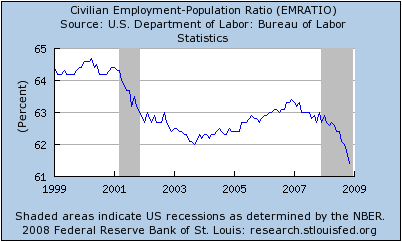
As I write this post, I am entering my second month of unemployment. I had been at my last job for 10 years when I was unceremoniously let go. Of course I was not alone last month; I was one of 533,000 who have joined the now 10.3 million unemployed. The picture looks quite dismal.


The horrible thing is that the unemployment picture is actually much worse that the above picture would lead you to believe. You see, unemployment figures only measure the number of people who file unemployment claims with the government. A more sobering metric is percent employment: in other words, # people employed/population. Granted, this includes (as far as I know) children and retirees, but it also includes the multitudes who no longer qualify for unemployment benefits, or never qualified because they were employed part time, or have just given up looking for work. I know people in those categories.

Below is a chart (which I shamelessly stole from Paul Krugman) showing the trend of percent employment over the last 10 years.


What I'm seeing above is an honest representation of what the Bush XLIII presidency has done to the American worker. Bush has been a complete failure and his riddance is beyond good. But I'm not a veritable pessimist and I do have a great deal of hope for the future.

Friday, November 28, 2008

Friday Cephalopod: Octu Vishnu

I hope Greg Laden doesn't think that he's the only one who can muscle in on PZ's territory.


Octu Vishnu from the 2008 Kensington Kinetic Sculpture Derby.

Tuesday, November 25, 2008

MoralMaster 2.0 Morality Monitor

It appears that I'm not a very moral person.

Friday, November 21, 2008

Louis CK is great!

I've been a fan of Louis CK for quite a while now. But I was just reminded of him by this latest post by Phil Plait. (I highly suggest that you watch the Conan interview on Phil's post!) Anyway, the video below (I can't remember if I posted it before) is the reason that I first became a Louis CK fan. Anyone who can make me laugh so hard that I cry, just by making fun of the Catholic Church (Dave Allen, RIP), is a genius in my book.

I've been tagged!

I've been tagged by The Darwin Report. Here are the rules of the tag game:

1. Link to the person who tagged you.
2. Post the rules on your blog.
3. Write six random things about yourself.
4. Tag six people at the end of your post and link to them.
5. Let each person know they’ve been tagged and leave a comment on their blog.
6. Let the tagger know when your entry is up.


Geez Louise!!! OK, I've faithfully completed the first two assignments, let's see how well I do on the others.

6 arbitrary facts about myself:

1. Wait a minute! Wasn't I supposed to post 6 random facts about myself? Indeed! Arbitrary fact #1 is that I hate it when people use the word random when what they really mean is arbitrary. Clearly, if I'm picking the 6 facts, then they're arbitrary. The only way that they could be considered random would be if you defined random to mean unrelated. But that flies in the face of most common usages of the word. (It might also work if I picked the facts out of a hat, but then which facts to put into the hat was still an arbitrary decision. So I guess in that case, the facts would be both random and arbitrary.) These facts are just arbitrary. I guess that means that technically, I broke one of the rules. (It won't be the last one I break.)

2. I sleep with a pillow between my legs.

3. I make my own wine. I make it from kits, so no growing or crushing of grapes, but who knows what the future will hold.

4. My grandfather's name was Darwin. My great-grandfather was Irish Catholic, and my great-grandmother was Protestant. Back during the turn of the century (not this latest one, but the one before) this kind of mixed marriage was frowned upon and my great-grandparents were quickly disowned by their respective families. They became Unitarians and named their son Darwin. I'm guessing that part of the motivation for the latter had to do with my grandfather being born in 1909. Anyone following the festivities planned for 2009 will recognize the significance of that date. This certainly wasn't lost on my great-grandmother who was a big fan of science and nature and history (or at least I'm told so).

5. My nephew is named Darwin. OK, so he hasn't been born yet and Darwin is his middle name. (His first name is Rafael--also a family name: from my father's side. Or maybe my sister named him after a turtle.)

As a math buff, I would so love the beautiful numerical symmetry of young RADAR being born in 2009. However he is due before then, and I certainly don't wish an extra half month of pregnancy on my sister for the sake of symmetry. Or dooo I?

6. This evening, after a really nice lecture by Janet Browne, I was stood up by PZ Myers! After promising to show up for Drinking Skeptically, he decided to ditch us instead. In all fairness, he did warn me that he would be late, but the word late implies actually showing up! PZ did no such thing! Can you even begin to imagine my shame? Several people at DS asked "Do you think that PZ Myers will show?" I assured them all that since I had just spoken with him and he said he would be running late, that indeed he was going to show up. What a fool I was! Fool me once, call me a ... er... won't get fooled again. ;-)

Back to the instructions: Consider #'s 5 & 6 to be done. That leaves #4 (Tag six people at the end of your post and link to them.) to resolve. Once again, I'm going to break the rules. I had several people in mind (including a fellow whose surname is spelled just like the al Quaida kingpin, but he's surely busy counting votes), have decided to tag only one other. I tag PZed Myers!! It is well known that he has an unhealthy obsession with spineless creatures, but will he pay his penance and not be spineless himself? How dare he skip out on our skeptical night!! We had great conversations about physics, philosophy and Religulous, all of which you missed out on.

PZed! You (at the very least) owe us a "6 facts" tag post! Get on it!!!

Friday, November 07, 2008

Fail for the Win!

This video is predictable, but hilarious!

Tuesday, November 04, 2008

Vote!

GO VOTE NOW!!!

In the meantime, here's a little Randy Newman-esque song from the Code Monkey dancer.

Friday, October 31, 2008

Life of a Pumpkin

Sorry for the late posting, but please consider this a revival of my old Friday Madness series.

Monday, October 27, 2008

The Vet who did not vet.

This was just too cute not to share.

Saturday, October 18, 2008

Friday, October 10, 2008

The Devil In Dover

What does it mean to be objective? The current meme seems to be that objective means "unbiased" and balanced. The trouble is that no human thought is unbiased, and balanced coverage isn't always (or even usually) truthful. I firmly believe that it's important to get every side of a debate before making an informed decision, but He Said, She Said coverage makes opposite positions seem equal when most often there is quite a disparity. Cenk Uygur of The Young Turks likes to say that if sports reporters acted like the mainstream media, then every game would be a tie or a nail-biter--even when it was a clear blow-out! And New York Times columnist Paul Krugman famously said "If Bush said the Earth was flat, the mainstream media would have stories with the headline: 'Shape of Earth - Views Differ.' Then they'd quote some Democrats saying that it was round."

The above examples may seem like blatant hyperbole, but any informed reader who's familiar with the mainstream media's science coverage will recognize that they're not that far off. Science deals with verifiable facts. From a scientific perspective, "balance" means that every competing hypothesis (theoretically) gets the same chance to methodically test it's claims. But claims that fail the test don't get to sit at the same table as those that are tried and true. It would be nice if journalism worked the same way. But wait, it's supposed to. Here's a quote from an essay by the Committee Of Concerned Journalists that spells it out perfectly.

Perhaps because the discipline of verification is so personal and so haphazardly communicated, it is also part of one of the great confusions of journalism- the concept of objectivity. The original meaning of this idea is now thoroughly misunderstood, and by and large lost.

When the concept originally evolved, it was not meant to imply that journalists were free of bias. Quite the contrary. The term began to appear as part of journalism after the turn of the century, particularly in the 1920s, out of a growing recognition that journalists were full of bias, often unconsciously. Objectivity called for journalists to develop a consistent method of testing information- a transparent approach to evidence- precisely so that personal and cultural biases would not undermine the accuracy of their work.


This is quite different from the "balanced" approach that dominates the media today. This can clearly be seen in how the Intelligent Design "controversy" was covered. This attempt to be balanced and unbiased led to charlatans and prevaricators being given a stage that they neither earned nor deserved. One of the shining lights of truly objective journalism during the whole debacle was Lauri Lebo. Her newest book The Devil In Dover, details her account as a reporter covering the Kitzmiller v. Dover Area School District trial in central Pennsylvania over teaching Intelligent Design.


Lauri tells the tale of the trial from when the idea of teaching Creationism was first floated to the aftermath. The reader gets to meet all the defendants and admire them for their courage. You get to see the lawyers from the ACLU, NCSE, and Pepper-Hamilton plan their tactics and strategy for the trial. You get to really see the contrast between Brown Biology professor (and author of textbook Biology) and defense witness, Lehigh University biology professor (and author of the critically panned Darwin's Black Box).

This was exciting for me since I was one of those who followed the trial as it unfolded. Reading this book was like reliving the trial, but being there. What I really found to be new was that I also got to "meet" the plaintiffs. As a local, Lauri Lebo actually knew Bill Buckingham (who attended the same church as her born-again father) and other school board members. These were basically good people who were willing to lie to advance their agenda. I know, it sounds like an inherent contradiction, but when saving souls is more important than not bearing false witness (or just about any other virtue), than anything pretty much goes. I can't say that I particularly like any of those board members more since reading The Devil In Dover, but I do feel that I've been given a window (or at least a peephole) into their motives. I'm sure that I wouldn't much care for any of those characters (or even Dean Lebo) if I ever met them had I not been given that window. The defendant's lawyers from the Thomas More Law Center didn't come off quite as sympathetically. But that might just be that Lauri never quite got to know them as well--or maybe they were that much slimier.

But make no mistake, the heroes of the book are most certainly the parents, teachers and lawyers on the plaintiff's side. They stood up to ignorance and won! Here's a couple of paragraphs from the end of the book that talk about the atmosphere in Dover science classes after the trial.

Rob Eshbach sat with students in quiet classrooms after school, speaking of balancing science with his faith. Jen Miller inspired students to gaze down long hallways and into our past. But these children of pastors always taught evolution with trepidation, afraid of offending creationist beliefs. This year, that's changed. Miler has revamped the biology curriculum. The teaching of evolutionary theory will no longer be crammed into a handful of days out of the school year. Now teachers start with evolution—because everything in biology builds from the theory.

Bryan Rehm says Dover high school is now the safest place in the country to teach science. Attacks on evolution continue in other classrooms, in other places, quietly, out of sight of newspaper reporters and public scrutiny. But not in Dover. Too many people are now watching.


This is exactly right because as Theodosius Dobzhansky said, "Nothing in Biology Makes Sense Except in the Light of Evolution." The fact that most high schools in this country still teach evolution as an afterthought or just a minor aspect of biology is criminal. Even more criminal (as stated in the second paragraph from the above quote) is that attacks on evolution are still widespread. Why can't it be "safe to teach science" everywhere?

Verdict: Buy the book!

UPDATED: Video of Lauri Lebo talking to the Freethought Society of Greater Philadelphia

Friday, September 19, 2008

Sing like a pirate!

In honor of Talk Like A Pirate Day, I bring you the latest spiffworld video.

Thursday, September 04, 2008

Who's kingdom?

I was browsing through The "Blog" of "Unnecessary" Quotation Marks today when I saw yesterday's post. Haha! It just speaks for itself.

Wednesday, September 03, 2008

Moon transit shot from EPOXI spacecraft

EPOXI's Spacecraft Observes the Earth-Moon System


Videos of the Moon transiting the Earth, as imaged by NASA's EPOXI spacecraft, were made from the still images collected when EPOXI's spacecraft imaged the Earth-Moon system on 28-29 May 2008. When the images were acquired, the spacecraft was just outside the orbit of the Earth and ahead of Earth by 31 million miles, 1/3 AU, making it as far from Earth as Mercury is from the Sun.


(via APOD)

Thursday, August 14, 2008

Enfeebled Fables

Once upon a time a hare saw a tortoise walking slowly along and began to laugh and mock him. The tortoise challenged the hare to a race and the hare, thinking himself the fastest animal around, accepted. They agreed on a route and started off the race. The hare shot ahead and ran briskly for some time. Then seeing that he was far ahead of the tortoise, he thought he'd sit under a tree for some time and relax before continuing the race.

He sat under the tree and soon fell asleep. The tortoise, plodding on, overtook him and closed in on the end of the race. The hare woke up and realized that he had been passed. He dashed off as fast as he could towards the finish line only to reach his goal together with the tortoise. Unsure of who had won, the hare looked up at the officials' table.

Both competitors were promptly presented with identical, generic, appreciation medals. The head race official then announced "Today there are no losers. Everyone is a winner and we were able to raise money for a great cause."


What is wrong with the above story? Let me tell you: it has no teeth! Fables, parables, and fairy tales are supposed to teach moral lessons about life. However, when you change the story around to make it more pleasant or to give it a happy ending, you often remove the part that contained the vital lesson. What are you left with then? Can we say that the above story even has a moral anymore? I would say no. The appropriate response to the above story is to ask "So what's the point?" The Moral of the original fable has been stolen.

Speaking of the Moral of the original fable, I need to briefly digress so that I may rant a bit on a related topic. What is the Moral of the original fable? You've probably been taught, just like every-frickin-body else, that it's "Slow and steady wins the race."
NO NO NO!!!


That may be the stated Moral of the story, but it's certainly NOT the actual Moral! That's not what the original fable taught us. Let's be clear here, slow and steady does not win the race. Fast and steady wins the race. Smart and steady wins the race. (Or, in bicycle racing, positioning oneself well for the final sprint wins the race.) The tortoise didn't win by racing slow and steady; he won because the hare screwed up! If the hare races a smart race, he wins EVERY time!

The stated Moral for the fable of the Tortoise and the Hare is simply wrong. The actual Moral of the story is "Hubris loses the race." I'm amazed that more people don't see that.

Now that I've got that out of the way, it's time to return to our regularly scheduled rant. You see, what I just did above to the Fable of the Tortoise and the Hare (to make my point) has actually been done (and successfully) to other famous stories. What you end up with is a pointless, feel-good story that bears an eerie resemblance to a story that actually had a message. I consider this a sin because it's a dumbing down of the narrative--albeit with good intentions--leading to less honed thinking skills for our children. Even if you disagree with the Moral of a particular story, dumbing it down is not the answer. You could, for example, rewrite the story so that the Moral reflects more contemporary values. But don't eviscerate it! You can also just read the story as is then discuss with the child what they think about the Moral (kids can be pretty smart, you know). But when the Moral is pretty much removed from the story, or watered down to the point of being functionally dead, I must step up and object.

My next example is The Tale of The Three Little Pigs. I'm assuming all of you know the more familiar, Disney-fied version of the story. Below is a six minute video of me reading the original version. See if you can spot the differences (besides my creative use of food props) between it and the diluted version.


If you just watched the video, then surely you noticed the the first two little piggies got eaten by the big bad wolf. (This story also made it clear that the third little pig didn't only plan better than the other two, but he wasn't lazy or gluttonous like them either.) Some of you may think that that's a bit rough for kids, but the Moral here is lucidly explicit--unlike the familiar version. What is the Moral of the tale's modern incarnation? "Make sure you work hard and plan well, but if you don't, don't worry because everything will work out in the end."?? Huh???

It's a sin I tell you! A sin!!

I might not be so bothered by a pointless children's story if it wasn't for the fact that it has supplanted its ancestor that actually had a real message (for what it's worth).

Anyway, I'll leave you on an upbeat note (that was meant to be taken musically, not figuratively). I've always liked The Devil Went Down To Georgia by the Charlie Daniels Band. It's a catchy, danceable song that's hard not to like. The lyrics, however, are a complete corruption of the FAUST legend. See if you can figure out how (IMO) they disemboweled that classic storyline of its Moral. (hint: Accepting the golden gift is the DEFINITION of "selling out".)