Today I will be partaking in my first Hash House Harriers run. I've heard good things about these runs. For one, one need not be super fit to do it.
In most groups, all are welcome, young and old, fast or slow, so don't wait to get in shape, just come on out and join us.
Okay, I can do that. My biggesst worry is if I'll be able to follow all the rules. It seems this particular HHH group has strict rules which are enforced by the Religious Advisor. The penalty for violating a rule is to drink beer. I'm told that everyone violates the rules--I don't know if I can handle that.
To show how serious this all is, I will do the run dressed a a vicar. It should be fun.
UPDATE:
The run has been completed and I must say that I have found "my people." As you can see, the entire family got into the spirit of the run.
I should mention that my dad (wearing a pretty lame vicar's costume) is not wearing the tasteful tie my sister offered him as a gift. In fact, he resoundly refused it and so Stefan is wearing it in the picture.
When I asked him "Father, why do you not wear the beautiful tie your eldest daughter has so graciously furnished you with?"
He replied "Since my absolute disdain for the lie that is the Christian mythology is quite well known among my acquaintances, to be seen wearing that tie in public would be tantamount to wiping my ass with the tie, then using it to mop up cat vomit, before micturating all over it. I'm not quite ready to make that statement, but perhaps in the next couple of months I might consider doing to that tie what this fellow did to the Bible." (WARNING: potentially offensive video at previous link!)
Insects manage some pretty amazing aerial acrobatics for having a brain we humans can hardly see with the unaided eye. Yet even our best engineers and AI experts have trouble programming simple autonomous navigation. Just look at what it took to finish The Grand Challenge.
Now researcher Nicolas Franceschini, a neurophysiologist and engineer at France’s National Center for Scientific Research and at the University of the Mediterranean in France has decided to emulate those little bug brains in his newest project.
The simple principles that Franceschini and his colleagues think underlie insect flight have to do with visual cues. As insects fly, their ground view changes depending upon their height above the ground and their speed relative to the ground. Essentially, the higher the insect, the slower the ground will appear to sweep below it.
The changing view that insects have of the ground, known as "optic flow," thus encodes details on both an insect's height and velocity. Franceschini and his colleagues speculated that insects rely on simple relationships between their height and velocity to keep flying. Basically, the idea is that if they slow down, they will begin descent, and if they speed up, they will begin climbing. By the same token, if they are descending, they will slow down, and if they are climbing, they will speed up.
"They don't need a speedometer or altimeter. They just need to use their eyes," said Franceschini, whose latest work on this topic is detailed online in the Feb. 8 issue of the journal Current Biology.
That's pretty cool stuff. A simple feedback system controls both speed and altitude--ain't evolution grand? Of course, such a simple system can sometimes trip up.
Their findings also help illuminate the basis for a number of previously unexplained observations regarding insect flight. For instance, honeybees often drown when flying over very still water. "There are no contrasting features in their field of view then, so they have no visual cues to go by," Franceschini said.
Franceschini's helicopter is equiped with a 200 mg. electronic brain, is tethered to a maypole, and free to fly around. At least under these simple circumstances, it seems to behave just like a fly.
This morning I received a curious e-mail on one of the listservers I belong to. It's great to have a Friday Madness topic just fall into my lap.
Zeus was equipped with a thunderbolt, Krishna with a 'Bramastra' weapon. Ancient Nuclear Warfare
"Anybody not wearing 2 million sunblock is gonna have a real bad day. Get it?" --Sarah Connor, Terminator 2
"Thank you, India." --Alanis Morissette
There is evidence that the Rama empire (now India) was devastated by nuclear war. The Indus valley is now the Thar desert, and the site of the radioactive ash found west of Jodhpur is around there.
Consider these verses from the ancient (6500 BC at the latest) Mahabharata:
...a single projectile Charged with all the power of the Universe. An incandescent column of smoke and flame As bright as the thousand suns Rose in all its splendour... a perpendicular explosion with its billowing smoke clouds... ...the cloud of smoke rising after its first explosion formed into expanding round circles like the opening of giant parasols...
..it was an unknown weapon, An iron thunderbolt, A gigantic messenger of death, Which reduced to ashes The entire race of the Vrishnis and the Andhakas. ...The corpses were so burned As to be unrecognisable. The hair and nails fell out; Pottery broke without apparent cause, And the birds turned white.
After a few hours All foodstuffs were infected... ...to escape from this fire The soldiers threw themselves in streams To wash themselves and their equipment.
Until the bombing of Hiroshima and Nagasaki, modern mankind could not imagine any weapon as horrible and devastating as those described in the ancient Indian texts. Yet they very accurately described the effects of an atomic explosion. Radioactive poisoning will make hair and nails fall out. Immersing oneself in water gives some respite, though it is not a cure.
When excavations of Harappa and Mohenjo-Daro reached the street level, they discovered skeletons scattered about the cities, many holding hands and sprawling in the streets as if some instant, horrible doom had taken place. People were just lying, unburied, in the streets of the city. And these skeletons are thousands of years old, even by traditional archaeological standards. What could cause such a thing? Why did the bodies not decay or get eaten by wild animals? Furthermore, there is no apparent cause of a physically violent death.
These skeletons are among the most radioactive ever found, on par with those at Hiroshima and Nagasaki. At one site, Soviet scholars found a skeleton which had a radioactive level 50 times greater than normal. Other cities have been found in northern India that show indications of explosions of great magnitude. One such city, found between the Ganges and the mountains of Rajmahal, seems to have been subjected to intense heat. Huge masses of walls and foundations of the ancient city are fused together, literally vitrified! And since there is no indication of a volcanic eruption at Mohenjo-Daro or at the other cities, the intense heat to melt clay vessels can only be explained by an atomic blast or some other unknown weapon. The cities were wiped out entirely.
While the skeletons have been carbon-dated to 2500 BC, we must keep in mind that carbon-dating involves measuring the amount of radiation left. When atomic explosions are involved, that makes then seem much younger.
Interestingly, Manhattan Project chief scientist Dr J. Robert Oppenheimer was known to be familiar with ancient Sanskrit literature. In an interview conducted after he watched the first atomic test, he quoted from the Bhagavad Gita: "'Now I am become Death, the Destroyer of Worlds.' I suppose we all felt that way." When asked in an interview at Rochester University seven years after the Alamogordo nuclear test whether that was the first atomic bomb ever to be detonated, his reply was, "Well, yes, in modern history."
Ancient cities whose brick and stonewalls have literally been vitrified, that is, fused together, can be found in India, Ireland, Scotland, France, Turkey and other places. There is no logical explanation for the vitrification of stone forts and cities, except from an atomic blast.
Another curious sign of an ancient nuclear war in India is a giant crater near Bombay. The nearly circular 2,154-metre-diameter Lonar crater, located 400 kilometres northeast of Bombay and aged at less than 50,000 years old, could be related to nuclear warfare of antiquity. No trace of any meteoric material, etc., has been found at the site or in the vicinity, and this is the world's only known "impact" crater in basalt. Indications of great shock (from a pressure exceeding 600,000 atmospheres) and intense, abrupt heat (indicated by basalt glass spherules) can be ascertained from the site.
Wow! I had never heard THAT one before. This is priceless. It also goes against the grain of most conspiracy theories. Most of the freak stories I'm familiar with work from the premise that ancient and primitive peoples were too simple to accomplish any worthwhile engineering feats (eg. "Aliens built the pyramids/Easter Island statues." etc.), so there must be a fantastic explanation.
This beauty seems to go the other way and say that ancient peoples had nuclear technology. Wow! Perhaps their secret to enriching Uranium has been forever lost. That is truly a pity. If only they hadn't used their vile technology to wipe out their own knowledge--I think there might be a moral lesson here.
But don't despair, the ancient religious writings that stand witness to those horrid events have survived to this day. And furthermore, they are corroborated by claims of archeological evidence that are at best specious if not outright fictive.
My favorite part is:
While the skeletons have been carbon-dated to 2500 BC, we must keep in mind that carbon-dating involves measuring the amount of radiation left. When atomic explosions are involved, that makes then seem much younger.
Actually, it measures isotope ratio. And furthermore, the type of radiation emited during a nuclear detonation has never been shown to alter the carbon isotope ratio. I could go on, but I prefer to sit back and enjoy the fairy tale. If only all Fridays were this easy.
When I first saw this article, Tricky Parasite Creates Deadly Threesome, on LiveScience, I thought it was going to be about the parasites I had seen earlier on Joshua's blogpost Hot three-way action with grass and 'shrooms. It turns out they have nothing to do with each other. I guess the word threesome just has too much sex appeal to resist using in the title (not that I'm guilty of that).
Joshua's post is on a paper that appeared in Science about plants near the hotsprings in Yellowstone that become resistant to heat if they're infected with a specific parasitic fungus which itself must also be infected by a specific virus in order for the heat resistance to be established (Wow!).
The LiveScience article is about a parasitic worm that swaps hosts between a shrimp-like crustacean (amphipod) and a predatory fish. Like other parasites, upon maturing this worm (Pomphorhynchus laevis) causes its host (the amphipod) to change its behavior and actually seek out its predators.
Check out the hooks the worm uses to latch onto its host. Ewww!
I cdnuolt blveiee taht I cluod aulaclty uesdnatnrd waht I was rdanieg The phaonmneal pweor of the hmuan mnid! Aoccdrnig to a rscheearch at Cmabrigde Uinervtisy, it deosn't mttaer inwaht oredr the ltteers in a wrod are, the olny iprmoatnt tihng is taht the frist and lsat ltteer be in the rghit pclae. The rset can be a taotl mses and you can sitll raed it wouthit a porbelm. Tihs is bcuseae the huamn mnid deos not raed ervey lteter by istlef, but the wrod as a wlohe. Amzanig huh? Yaeh, and I awlyas thought slpeling was ipmorantt.
I received the above paragraph in an email today and was quite surprised at how easily I was able to read it. Whole words indeed. While the explanation may seem counter-intuitive, it actually fits well with my experience. As a crossword puzzle afficionado, I oftentimes find myself stuck for the longest time, only to realize that I had been misreading the clue. (“Imitate friendship?” What was I thinking?) Looking back, I’m sure that every time, I’ve always confounded the clue for another word with the same first and last letters. I’ll have to pay closer attention the next time it happens to me.
That mixed-up paragraph also reminded me of an article in Scientific American on the Expert Mind. The author, Philip Ross, discusses a study done by Dutch psychologist Adriaan de Groot that demonstrated that chess grandmasters could recall chessboard positions much better than novices.
De Groot also had his subjects examine a position for a limited period and then try to reconstruct it from memory. Performance at this task tracked game-playing strength all the way from novice to grandmaster. Beginners could not recall more than a very few details of the position, even after having examined it for 30 seconds, whereas grandmasters could usually get it perfectly, even if they had perused it for only a few seconds. This difference tracks a particular form of memory, specific to the kind of chess positions that commonly occur in play. The specific memory must be the result of training, because grandmasters do no better than others in general tests of memory.
While that may not seem at all surprising, the following study might. It starts to get to the heart of why grandmasters have such superior recall.
In the 1960s Herbert A. Simon and William Chase, both at Carnegie Mellon University, tried to get a better understanding of expert memory by studying its limitations. Picking up where de Groot left off, they asked players of various strengths to reconstruct chess positions that had been artificially devised--that is, with the pieces placed randomly on the board--rather than reached as the result of master play. The correlation between game-playing strength and the accuracy of the players' recall was much weaker with the random positions than with the authentic ones.
If this sounds confusing, or if you’re wondering what this all has to do with the shuffled-up words, perhaps this will explain.
Psychologist George Miller of Princeton University famously estimated the limits of working memory--the scratch pad of the mind--in a 1956 paper entitled "The Magical Number Seven, Plus or Minus Two." Miller showed that people can contemplate only five to nine items at a time. By packing hierarchies of information into chunks, Simon argued, chess masters could get around this limitation, because by using this method, they could access five to nine chunks rather than the same number of smaller details.
Take the sentence "Mary had a little lamb." The number of information chunks in this sentence depends on one's knowledge of the poem and the English language. For most native speakers of English, the sentence is part of a much larger chunk, the familiar poem. For someone who knows English but not the poem, the sentence is a single, self-contained chunk. For someone who has memorized the words but not their meaning, the sentence is five chunks, and it is 18 chunks for someone who knows the letters but not the words.
In other words, our brains are constantly using our experiences to create short cuts. We learn to recognize familiar patterns. When we later encounter the familiar pattern, our brains process it as a single bit of information, allowing us to streamline our thinking and be more efficient.
I want to hold you 'til I die! Archeologists in Italy have unearthed a Neolithic couple who apparently died in each other's arms. I say apparently because they may have been placed like that 5-6K ago by whoever buried them. But that they're hugging is undoubtable. Judge for yourself...
Tony Dungy really made today's post easy. After pondering yesterday over who Jesus would favor in the Superbowl, I now have my answer: Jesus likes the Colts. The Colt's head coach said so much.
In the awards ceremony in Dolphin Stadium, CBS announcer Jim Nantz asked Dungy to comment on the significance of being the first African American head coach to lead a team to a Super Bowl victory. "I’m proud to be representing African American coaches," Dungy said. "... It means an awful lot to our country."
But Dungy continued: “More than anything – and I’ve said it before -- [Chicago coach] Lovie Smith and I [are] not only the first two African-Americans, but Christian coaches, showing that you can win doing it the Lord’s way,” Dungy told Nantz while holding the Vince Lombardi Trophy given to each year’s NFL champion.
“And we’re more proud of that.”
I guess he missed Mr. Deity's press conference. The important point is that you can win doing it the Lord's way. What a relief! But wait a minute, isn't Lovie Smith a Christian too? Why did Jesus slight him? And besides, Nantz asked him about being the first African American coach to win. What's with the Jesus, then? Does he think he's the first Christian coach to win the Superbowl?
I swear that the Jesus juice must kill at least half the brain. Amen!
It's Superbowl time! The big question now is "Who will God give the game to?" Back in 2000, God made the Rams win, as evidenced in the testimony of winning quarterback Kurt Warner.
Immediately after the Rams' victory at the Super Bowl, an interviewer began, "Kurt, first things first--tell me about the final touchdown pass to Isaac." Kurt responded, "Well, first things first, I've got to thank my Lord and Savior up above--thank You, Jesus!"
Obviously Jesus didn't like the Titans, but can you blame him? After all, Titans are pagan gods--false gods. In my exhaustive search, I was unable to find a video of that fabulous interview. I did, however happen upon this Real Time clip of Bill Maher and Andrew Sullivan talking about Mr. Warner's opposition to stem cell research.
I am compelled to say a few words on that clip--not for anything Kurt Warner said (he's clearly an idiot) but Andrew Sullivan is actually pretty smart. He says:
"I live with a disease that ten years ago they told me I'd be dead by now ... HIV. And they worked really hard and they managed to create a set of pills that keep me alive. And I thank God for those pharmaceutical companies that did that, by the way."
Hey, at least he acknowledged the middleman. So let's see. God (who delivered Kurt Warner's victory) first gave us AIDS (to punish our society per Jerry Falwell), then gave us the pharmaceutical companies to develop treatments. What a wacky guy--mysterious ways indeed.
But none of this answers the important question about tonight's game. I think the only solution is to ask Mr. Deity himself.
You should check out the other Mr. Deity episodes. You might find Lucifer tempting; I know I felt the heat--Hell Hath No Fury!
I know this is the wrong day of the week for this, but I couldn't resist. It seems that Mr. Rael is an ardent atheist and a strong supporter of atheist causes. That's right, Rael the cult leader is against religion. He's all about science. After all, he did clone a human. He even has his own theory of origins which is superior to evolution. Wow!
Anyway, it turns out he has taken the blasphemy challenge. His video is a strange eclectic mix of delusional rantings and heavy sales pitches for his cult and it's associate websites (Warning: Don't watch it if self-serving lunatics make your stomach turn). I tried to leave a comment asking about how the young clone is doing, but Rael is monitoring comments. "Your comment will be posted as soon as it is approved." What do you think are the odds that my comment will ever show up?
Today Punxsutawney Phil, the famous Woodchuck, didn't see his shadow and so foretold of an early spring. I caught up with Phil after the momentous event.
"Hello Phil, you look very tired."
"Yes Javier, it's been a very long day. It seems like you're the millionth person I've talked to today."
"Well then, I'll keep it brief--and not ask about your shadow."
"Thank you."
"So tell me Phil. How much wood would a woodchuck chuck, if a woodchuck could chuck wood?"
"That's a very good question, Javier. And believe it or not, I actually get that question a lot. I would have to say that ... a woodchuck would chuck all the wood he could chuck, if a woodchuck could chuck wood."
I would like to take a moment to welcome our hemisphere's newest elected dictator. While I'm grateful that he doesn't control a superpower like the United States, it is troubling that he's sitting on top of a lot of oil. His recent attacks on George W. Bush—calling him el diablo—have endeared him to many on the left. Though I have no love for Mr. Bush (an understatement), I emphatically disavow any and all Chavez apologists.
Q: Your opponents are saying that you are beginning a slow-motion dictatorship. Is that what we are seeing?
Hugo Chávez: They have been saying that for a long time. When they’re short of ideas, any excuse will do as a vehicle for lies. That is totally false. I would like to invite the citizens of Great Britain and the citizens of the U.S. and the citizens of the world to come here and walk freely through the streets of Venezuela, to talk to anyone they want, to watch television, to read the papers. We are building a true democracy, with human rights for everyone, social rights, education, health care, pensions, social security, and jobs.
His responses throughout the interview showed a remarkable consistency in their level of honesty. But let's see, how honest was he in his first response? According to Dictionary.com,
dic·ta·tor –noun 1. a person exercising absolute power, esp. a ruler who has absolute, unrestricted control in a government without hereditary succession.
I can't help but notice that the definition says nothing about democracy or human rights. It only talks about absolute power and non-hereditary succession. Certainly, as yet, Venezuela has no hereditary succession. But does Chavez have absolute power?
The new law -- which Chavez has dubbed the "mother of all laws" -- gives him the power to transform state institutions in 11 key sectors, including the economy, the military, transportation, security and oil.
The measure giving him power to rule by decree was approved Wednesday by the entirely pro-Chavez National Assembly.
Gee, sound like a dictatorship to me. My favorite part of it all is this choice quote:
"We are going to enact it with a red ink and from today it will be in effect -- in the name of God and the revolution," Chavez told a news conference, referring to his signature Socialist color.
He's invoking both Marx AND God! Damn, that's sweet. Although he really should've signed it in heavy crude—after all, oil money is the opiate of the masses.
"Essentially, procrastinators have less confidence in themselves, less expectancy that they can actually complete a task," Steel says. "Perfectionism is not the culprit. In fact, perfectionists actually procrastinate less, but they worry about it more."
Other predictors of procrastination include: task aversiveness, impulsiveness, distractibility, and how much a person is motivated to achieve. Not all delays can be considered procrastination; the key is that a person must believe it would be better to start working on given tasks immediately, but still not start.
Oops, did I say today? I meant three weeks ago. I also meant to write about it three weeks ago, but I wasn't sure that I had anything constructive to add to the conversation. Now I've finally decided that I have something to say, hence this post. Not only have I ended my procrastination on this specific topic, but I'll be cutting back on stalling altogether for a while (or at least try). I'm throwing down the gauntlet!
February will be "new blog post per day month." That's right, every day (not just Fridays) I will post some new material. Starting tomorrow February 1st, here's the rules I'm imposing on myself:
Every day I will put up at least one new post.
At least one post each day must have a minimum of five sentences of original content.
The penalty for skipping will be 2^n original posts in one day (n = # of days where I violate one of these rules).
So basically, I can't just post a link or embed a video unless I include 5 sentences of commentary or have another post which is compliant. It shouldn't be that hard to pull this off. I've got a few ideas for some posts, but I imagine that most will be hurried ejaculations of whatever is on my mind. Not bad for a reworking of a failed New Year's resolution, eh? Maybe I'll even get around to resurrecting the nascent and comatose Science Pundit podcast.
A while back, Andrew Newberg, MD, Associate Professor of Radiology, Psychiatry, and Religious Studies, and Director for the Center for Spirituality and the Mind, at the University of Pennsylvania, did a study where he looked at brain scans (SPECT) of people experiencing glossolalia (speaking in tongues). This is the same Dr. Newberg who earlier did a SPECT study to see if meditation helped patients with early symptoms of Alzheimer's Disease.
I was intrigued by both those studies when I first read about them, but was disappointed when I saw the details. They reminded me of a Johns Hopkins study where researchers showed that "magic mushrooms" created a mystical experience (I had a lot of fun with that one on a previous post.) None of these studies actually showed anything. They didn't have proper controls. They weren't rigorously testing hypotheses. It seemed to me all they were doing was trying to find evidence for God so they could win the Templton Prize.
P.Z. Myers at Pharyngula gave Newberg a real "bitch-slapping" when he looked at the study. He explains the flaws much better than I can. In fact, I thought there was nothing more to say on the subject. That is, until I saw this debunking video made by (18 year old) Emily.
When I was young, I learned that dogs recognize each other by smell. My observations seemed to confirm this. Social animals need to recognize each other. Humans have evolved unique faces and the ability to visually distinguish them. We are primarily visual animals. Dogs come in all colors, shapes and sizes. But they were bred that way by an animal that likes to visually differentiate things; wild dogs (wolves) don't have anywhere near the diversity of our best friends. Can they tell each other apart with purely visual cues? I don't know.
They can certainly recognize their own species on sight (and sound), but can they only do this in persona? In other words, can they recognize their own type in a photograph or television image? I don't know about the photograph, but as for the television...
Okay, so this whole post was just an excuse to put up that pug video I found.
We have just entered into the zodiac constellation Aquarius. There's actually a little more to it than vague, fabricated fortunes from the daily paper; the zodiac is a good way to keep track of the sidereal year. Cider what, you ask? Simply put, the sidereal year is one complete orbit around the sun. The name comes from the latin word for star. Since the stars remain relatively fixed (compared to closer objects such as the moon and planets), they serve as a good metric to measure the year and determine dates. The zodiac are 12 constellations evenly spaced along the ecliptic--the plane formed by the Earth's orbit around the Sun. They can be used to gague our planet's position during its orbit. This might just sound like a year, why the fancy adjective? Because it turns out that there's more than one type of year.
Allow me to sidetrack by bringing up that there is more than one type of day. Ask your typical person on the street to define a day and tell you how long one is, you'll probably get an answer like "A day is he time it takes for the Earth to rotate once about its axis, and it lasts 24 hours." One rotation around its axis is a sidereal day since we can use the stars to track the rotation. However, the 24 hour day is the time the spinning Earth takes to line up the Sun to the same longitude. In other words, it takes the Earth just under 24 hours to spin one complete (sidereal) rotation. But during that interval, it has moved along ts orbital pass and so the Sun isn't lined up where it was at the start of the day. It must continue spinning a little longer to reach this point. Phil the Bad Astronomer has a great post explaining all this much better than I ever could hope to do.
Back to the year, besides the sidereal year, we also have a tropical year. This would be, for example, the time between winter solstices. This is determined by the tilt in the Earth. During the winter solstice (from the latin for "sun stop" or "sun pause" because it is the date when the sun's maximum position in the sky stops progressing and changes direction), the Earth's southern hemisphere is tilted towards the Sun while the northern is tilted away. The summer solstice is the opposite. The equinoxes occur when the tilt is perpedicular to the line with the sun, hence both hemispheres are equidistant from the sun. If the tilt of the earth were constant, then the sidereal and tropical years would perfectly jibe. But alas, it's not.
Which brings us to the precession of the equinoxes. (cool picture) Precession is a wobble. Think of a spinning top. Besides the primary spin, the top has a wobble which causes the axis to draw out a circle on the ceiling (ignoring proper movement of the top). The Earth is basically doing the same thing. It's tilt is slowly wobbling so that as time passes, the equinoxes and solstices fall at different times during the sidereal year. Therefore a time travelling astronomer should be able to tell you what century he's in by looking at the stars.
The Farnese Atlas is a 2nd-century Roman marble copy of a Hellenisticsculpture of Atlas kneeling with a globe weighing heavily on his shoulders. It is the oldest extant statue of the Titan of Greek mythology, who is represented in earlier vase-painting, and more importantly the oldest known representation of the celestial sphere. The sculpture is at the National Archaeological Museum (Museo Archeologico Nazionale ) in Naples, Italy. It stands seven feet (2.1 meters) tall, and the globe is 65 cm in diameter. ... In 2005, at a meeting of the American Astronomical Society in San Diego, California, Dr. Bradley E. Schaefer, a professor of physics at Louisiana State University, presented a widely reported analysis concluding that the text of Hipparchus' long lost star catalog may have been the inspiration for the representation of the constellations on the globe, thereby reviving an earlier proposal by Georg Thiele. The constellations are fairly detailed and scientifically accurate given the period of its creation, implying that the globe was modeled after a scholarly work. The position of these constellations is consistent with where they would have appeared in the time of Hipparchus - leading to the conclusion that the statue is based on the star catalog.
In other words, Dr. Schaefer used his knowledge of precession to figure out where the constellations would've been at the time the atlas was made, and determine that it was a star map.
As the Earth precesses through the zodiac, we go through different ages which are determined by which constellation we're in around the begining of the year. When I first found out that we we entering the age of aquarius, I got so excited because I thought that I had finally figured out what that song from Hair meant. Boy was I disappointed when I went to listen to the song again and heard nothing but astrological hippie nonsense. I certainly sympathize with Julia Sweeney and her revelation about Deepak Chopra.
Super science blogger Coturnix has released the science blogging anthology. It is a collection of the top 50 science blog posts as determined by other science bloggers. I didn't participate in the post review (due to the timetable limited by The North Carolina Science Blogging Conference, the whole nomination and selection process took a quick 3 weeks--half of which I was on vacation), nor did I submit a post of my own for consideration. (I felt bad as a mere lab monkey trying to rub shoulders with bona fide scientists.) But had I chosen to submit a post, it probably would've been my Von Neumman infinite series post--I really like that one.
Anyhoo, I've read most of the posts in the anthology and therefore highly recomend the book to anyone interested in science.
The second season of HBO's series Rome debuts tomorrow night and a certain blogger is very excited about it.
Last season ended with the assasination of Julius Caesar, and this season I envisage to be about the rise of Octavian (as brilliantly played by the talented Max Pirkis). It appears that the central event this season will be The Battle of Philippi. This was where the Triumvirate led by Octavian Caesar and Marc Antony defeated the armies of the conspirators Brutus and Cassius.
Here's how Anthony Everitt described the second battle (there were two battles over 24 days) in his book AUGUSTUS.
Late in the afternoon of October 23, he (Brutus) led out his troops and combat commenced. There seems to have been little in the way of maneuver; the two sides simply slugged it out like tired boxers. Octavian's troops fought bravely, and silence about his whereabouts suggests that their general was sufficiently recovered to lead them. Eventually they began to push the enemy back "as though they were tipping over a very heavy piece of machinery." Retreat turned to rout. Antony led the pursuit until night fell.
In other words, a bloodbath. It should make for good TV.
In the meantime, which Roman Emperor are you?
You scored as Trajan. You are quite fortunate to rank as the emperor Trajan, possibly the greatest of Roman emperors. You have relentlessly expanded the empire and even humbled the mighty Parthian empire. Loved by all, vastly larger than life, you are the model for all future emperors. It is hard to find a bad thing to say about you. HAIL CAESAR!
I'm back from my vacation now. Expect a blog about it soon (perhaps with a little primer on The Physics of Sailing).
Anyhoo, our pertinacious leader has made my choice for Friday Madness topic really easy: the proposed surge... did I say surge? I meant escalation. So in an effort to keep my blood pressure down, I'll just post a video.
For the three of you who read my blog regularly, I'll be on vacation for the next week celebrating the big XLI. I won't be able to post since I'll be on a boat and won't take my laptop with me (no Friday Madness this week).
Also, I just put up a post about free will I had started writing (then neglected) a couple weeks ago.
How do you defeat an extra-terrestrial monster, when bullets, torpedoes, missiles and lasers have failed? With Japanese style professional wrestling moves, of course.
Last weekend I went to see Jonathan Coulton at the Milkboy café in Ardmore, PA. Jonathan Coulton quit his job as a software engineer a little over a year ago in order to make music. When he didn't get a record contract right away, he started his "Thing a Week" project, where he came out with a new song every week for a year and podcast it for free under the Creative Commons license. Jen from A Thousand Times No interviewed him before the concert. You can listen to it here.
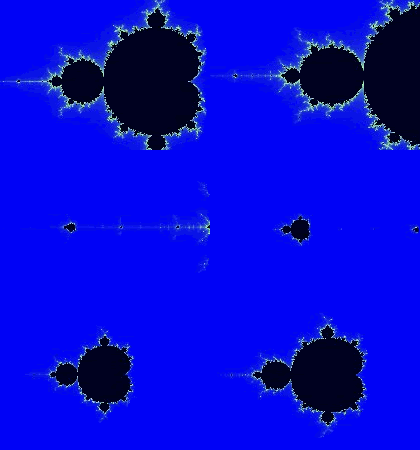
I watched some of his concert footage on YouTube, and in one show he said that he knew he was in the right place when a group held up their stuffed monkeys (a recurent theme in many of his songs). Right away I thought about how I could top that. Since I'm a fan of fractals, I decided to do something for his song Mandelbrot Set.
I generated a Mandelbrot Set image on my computer and had it printed poster size. I actually took a couple of pictures of Jonathan holding the poster I made, but alas, my P.O.S. camera screwed up and blurred the pictures by leaving the shutter open too long. Oh well, I guess I'll just have to wait until the next time he's in town. He did aknowledge me when he played Mandelbrot Set. He said "That gentleman holding the Mandelbrot Set poster has been following me around for a while. It's starting to get creepy!" He may have thought that he was just making a joke, but little does he know about my devious plan. It starts with stalking a singer/songwright, and finishes with world domination. BWA HA HA HA HA HA!!!!!
Speaking of which--What does a Mad Scientist give his girlfriend for Christmas? The answer is: probably not what she wants. According to a new study, couples tend to give each other the wrong gift.
· Almost half of all lovers are worse at predicting their partner's heart's desire than a stranger who simply uses average gender-specific preferences.
· In addition, the more you know about your inamorata, the worse your success rate is likely to get.
These cheerful holiday tidings are brought to you by "Why It Is So Hard to Predict Our Partner's Product Preferences: The Effect of Target Familiarity on Prediction Accuracy," in the December issue of the scholarly Journal of Consumer Research, published by the University of Chicago Press
And there's more to it than the cliché of getting your partner the gift that YOU want. (although that's a big part of it) In the article they talked about one guy who got is partner a bathroom scale as a gift. I imagine that his thought process must have been something like "Well she's always talking about her weight. I bet she'd really like a fancy new scale.
But what does any of this have to do with mad scientists or Jonathan Coulton, you ask? It's the JoCo song Skullcrusher Mountain. The song is about an evil-genius/super-villian who falls in love with the girl he's holding captive. My kind of guy! In the song, the protaganist is surprised when his beloved doesn't like the gift he got her.
I made this half-pony half-monkey monster to please you But I get the feeling that you don’t like it What’s with all the screaming? You like monkeys, you like ponies Maybe you don’t like monsters so much Maybe I used too many monkeys Isn’t it enough to know that I ruined a pony making a gift for you?
You might think that he's crazy for thinking that she would like such a monstrous gift. But the truth is that he was acting no diferently than any "sane" person would. It's just that for him, a grotesque chimera is the ideal for a gift. Perhaps that makes him a tad crazy--just a tad.
Flora, a komodo dragon in an English zoo is due to give birth to eight babies around Christmas. The catch is that Flora has not been with a male dragon. That's right, a Christmas-time virgin birth. Something about that just sounds familiar.
This kind of thing has been known to happen in other lizard species, but nobody knew it was possible with dragons.
"Nobody in their wildest dreams expected this. But you have a female dragon on her own. She produces a clutch of eggs and those eggs turn out to be fertile. It is nature finding a way," Kevin Buley of Chester Zoo in England said in an interview.
He said the incubating eggs could hatch around Christmas.
The process by which this happens is called parthenogenesis. From Wikipedia:
Parthenogenesis is distinct from artificial animal cloning, a process where the new organism is identical to the cell donor. Parthenogenesis is truly a reproductive process which creates a new individual or individuals from the naturally varied genetic material contained in the eggs of the mother. A litter of animals resulting from parthenogenesis may contain all genetically unique siblings. Parthenogenic offspring of a parthenogen are, however, all genetically identical to each other and to the mother, as a parthenogen is homozygous.
What this means is that the genome is not passed down whole as in cloning; The cells begin meiosis normally by fusing and shuffling their chromosomes, but instead of dividing into two separate haploid egg cells, they stay together essentially fertilizing themselves. The Wikipedia article has even been updated to include Komodo dragons.
Recently, the Komodo dragon which normally reproduces sexually was found to also be able to reproduce asexually by parthenogenesis. [3] Because of the genetics of sex determination in Komodo Dragons uses the WZ system (where WZ is female, ZZ is male, WW is inviable) the offspring of this process will be ZZ (male) or WW (inviable), with no WZ females being born. A case has been documented of a Komodo Dragon switching back to sexual reproduction after a parthenogenetic event. [4]. It has been postulated that this gives an advantage to colonisation of islands, where a single female could theoretically have male offspring asexually, then switch to sexual reproduction to maintain higher level of genetic diversity than asexual reproduction alone can generate. [5] Parthenogenesis may also occur when males and females are both present, as the wild Komodo dragon population is approximately 75 per cent male.
One has to wonder what these lizards, born of a virgin, on Christmas will be like when they grow up.
Congratulations to P.Z. Myers on winning the meaningless weblog award for best science blog. I have to confess that I was a bit torn. Pharyngula is the first blog I check every day. However, I've been reading Phil since the days of his old Yahoo listserve.
Anyhoo, as a tribute to the winner, I bring you a new species of giant squid. Here's a description of the "far red" camera and lure that was used to snag the shots.
The Eye-in-the-Sea (EITS) was designed to address these questions. The autonomous EITS is a programmable, battery-powered camera and recording system that can be placed on the sea floor and left for 24 to 48 hours to observe the animal life in the dark depths with as little disturbance as possible. It uses far red light illumination that is invisible to most deep-sea inhabitants and an innovative electronic lure that imitates the bioluminescent burglar alarm display of a common deep-sea jellyfish.
The very first time this lure was used it attracted a large squid that is so new to science it can not be placed in any known family.
Just follow this link to see the video of the depth dwelling cephalopod. (via New York Times)
Today is the tenth anniversary of Carl Sagan's demise. I have to admit that I missed Cosmos when it first came out. But I was intrigued by all the Johnny Carson jokes and the "billions and billions" schticks, so when the series was replayed I just had to watch it. I was blown away.
About a year later, I went to visit a friend who was attending Cornell University. The whole way there, all I could think about was "I hope I bump into Carl Sagan." Alas, I did not, but I did learn that Ithica is gorges.
Several years later, I got into reading popular science books and essays. Dawkins and Gould turned me on to evolutionary biology, but I also read Druyan and Sagan. The man was surely one of the premire poets of science. (I was a little disappointed by the movie Contact, although it did have its moments.)
Sorry for the lame post, but it's late and I want to get something up before the end of the day. There are some really nice tributes over at Joel's humanistic blog as part of the Carl Sagan blog-a-thon. Check them out.
And so this post won't be a complete wash, I present Carl Sagan and the Cosmic Calendar. Thank Google for embeded video.
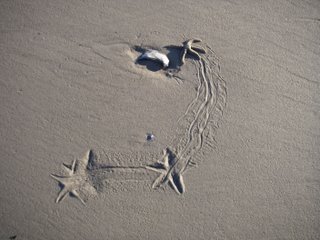
Two and a half months ago I wrote a post about a picture my sister took of a starfish on the beach. In that post I encouraged her to submit the picture to every photo contest she could find. She did. And now her picture is online at National Geographic. Awesome!
Scientists and judges have quite different ways of resolving issues. Courts set up a dichotomy of litigants, with each side getting equal weight (at least fair courts work that way). Each side gets to argue its case before the court (judge and/or jury of peers), and the side with the more persuasive argument wins. Each side gets to present evidence and question the opponent’s evidence, while the judge decides what evidence is admissible.
Science tries to accrue knowledge and reach the truth through research. Scientists look at the evidence, make hypotheses, and then test the hypotheses to see how valid they are. Their conclusions are then published in peer-reviewed journals where other scientists may scrutinize the work and gauge its validity. A consensus among scientists determines what is the accepted "truth." The journal’s editors decide which papers are worthy of publishing.
They sound similar, and in many regards they are, but there are a few crucial differences.
Science is an “open source” discipline. Scientists put all of their research and results out there for all to see and evaluate—including results that contradict their findings. It is considered a scandal when it is revealed that a scientist hid results from his peers and the public. (Is it a coincidence that most of the achievements that critics of science point to as being evil—atomic weapons, Nazi eugenics, etc.—were the result of science being performed behind closed doors? Just a thought.) In most court cases, the competing sides are under no obligation to disclose certain damning evidence to each other. In fact, attorney-client privilege often forbids it. This stems from the different mentality that the “truth” (verdict) is achieved by dispute resolution.
Judges are generally the preeminent experts in matters of law. This is ideal for complicated legal disputes. The "jury of peers" is a group of citizens who need only have an understanding of the law. This works well for most simple legal issues. "Scientific peers" are experts in the field of study in question. This is an absolute necessity for matters of scientific inquiry. Two scientists arguing dissenting theories can sound like they are speaking Greek (literally) to a layperson or even scientists outside of their field of expertise.
What happens when the two meet? This is a very sticky situation. Scientific disputes should be fought in the arena of science. Judges and juries are not qualified to evaluate an issue for which scientists have yet to reach a consensus. This sometimes happens, though. Even worse, scientific disputes in which a consensus has already been reached are oftentimes brought into the courtroom to be argued anew. Here they are subject to different rules, and the side with the better rhetoric can win the day.
Clearly, reforms are needed for when science meets law. I am however optimistic. The recent decision in the Dover, PA “monkey trial” and the reversal of the silicone implant ban give me hope for the future. Perhaps in ten years the courts will have institutionalized an organic system that is true to science for dealing with “science meets law” cases.
For this reason, our legal system, despite its problems, is a shining beacon of scientific enlightenment compared to many. This brings me to Libya.
A while back, I wrote a couple of posts about the Tripoli 6. These are the five Bulgarian nurses and Palestinian doctor who had been falsely accused of intentionally infecting Libyan children with HIV as part of a nefarious CIA/Mossad plot. Scientists stepped in and looked at the evidence. Their verdict was that the children were all infected (probably by the reuse of needles) prior to the arrival of the medics. They are clearly innocent! Then the Libyan court system stepped in and came to its verdict: guilty! Sentence: death!
Crowds cheered outside when the verdict was announced. I can’t really blame them so much (although I would never cheer anyone’s death sentence). It is unlikely that they knew about the scientific evidence, and quite likely that they wouldn't understand it even if they did know about it. It is truly sad and outrageous.
Last week Mickey Grant, maker of the documentary Injection about the plight of the medics, made a last ditch call to try to rally more worldwide awareness about this travesty. I really wish that I knew some real journalists who I could have pressured to cover the story. Alas, all I could do was sit back, watch the verdict, and feel impotent about the whole thing. This makes me sick to my stomach.
I still have hope, but I can’t say it’s realistic.
Last Friday, Point of Inquiry had an interview with Susan Blackmore. I found it altogether fascinating. It is well worth the listen. She talked about the out of body experience she had when in college. I have a pet theory as to what brought on her experience, but you'll have to listen to the podcast to find out what it is. She talked about how that experience led her down the path that would bring to where she is today. She also explained why she practices Zen Buddhism. But what really captivated me was when she spoke about free will.
I thought that I would be somewhat skeptical of her views. But after listening to her, I think our differences on the subject came down to what the definition of "free will" was. After all, depending on your approach, the question "What is free will?" can be just as difficult if not more than "Is there free will?"
So what is free will? You can't say that it's "not being affected by the outside world;" everything that interacts with its environment is affected by it. A reasonable definition then, would be "not being controlled from the outside." This tends to fit well with the basic idea of free will. It can get a little dicey when you go to draw the line for where "affected" ends and "controlled" begins. Let me give an example to illustrate more or less where I see that line. A mannequin is controlled by its puppeteer; it has no free will. But if the puppet is an autonomous robot, an autonomous robot that can rewrite its own programming based on experience, an autonomous robot whose decisions are complex and variable, then I would say that puppet has free will.
I would also say that autonomous robot is deterministic and probably doesn't have conscienceness--at least not in the way we think of it. This of course means that my definition will not be universally accepted, as I've heard the concept of free will tied to conscienceness and incompatible with determinism. I do not agree with those assessments.
I see no conflict between determinism and my definition of free will. A decision is a process; every process can be broken down into simpler steps. Once you get down to the simplest steps, they must fall into one of three (and only three) categories. Each step is either determined (cause leads to effect), random (effect not dictated by cause), or magic (undefined: almost certainly doesn't exist). This holds true whether you are talking about the base circuitry of wires or neurons, or the "higher software" that does the "thinking." In that sense, we humans are no different than the autonomous robot, and so if we can be said to have free will, then so can the robot.
Another thing I hear thrown about is statements to the effect of "the randomness of quantum mechanics liberates us from the bonds of determinism and allows us to have free will." That is utter nonsense. (quick note: The "randomness" of quantum mechanics is not haphazard; it follows established wave equations, it's experiments are reproducible, and the behavior is predicted by theory.) Besides, if one believes that strict determinism robs you of free will, how in the hell is random behavior any better? Hmm, let me think ... oh yeah, it's not! And furthermore, there's nothing stopping us from adding randomness to our "auto puppet." This puppet--this machine--must have free will just like we do. That only leaves magic, but magic doesn't exist. If your definition of free will requires magic, then free will, as so defined, does not exist.
This brings us to the issue of conscienceness. Nobody really knows what it is, therefore we can't really know whether out auto puppet has some form of it or not. There are behavioral tests out there that some people use to determine degrees of conscienceness (mirror test, turing test). But these behavioral tests leave many of us unsatisfied. We must rely on empathy. We watch a behavior for signs of conscienceness, but we can't know if it's really there. For example, the turing test is a test to see if an A.I. can fool a human into thinking that he or she is talking to another human. In that case, the conscienceness we would percieve in that A.I. (that passed the turing test) would be an illusion--or would it? And is our own conscienceness just an illusion? (Rene: That's not as outlandish as it may sound.)
Many see conscienceness as something ethereal; I think it is most certainly not. I see conscienceness as a web of sensations created by the brain. Take this letter written to NewScientist regarding this article.
The article on confabulation repeats a logical fallacy (7 October, p 32). "The idea that we have conscious free will may be an illusion," writes Helen Phillips, because a 1985 experiment "suggested that a signal to move a finger appears in the brain several hundred milliseconds before someone consciously decides to move that finger".
This is silly. The process of making a "conscious decision" to act is obviously not a single event. Factors for and against action must be weighed up, inhibitions must be overcome, environmental constraints must be checked, the muscular signals must be planned so that the action is properly coordinated, and so forth. That fact that somewhere along this complex pathway a signal can be measured indicating movement of a finger is imminent is quite unsurprising. The fallacy lies in inferring that the sensation of "conscious decision" that appears later on is thus illusory or "faked".
We sense all things in a delayed fashion. Our conscious recognition of a flash of light, for example, occurs well after the light actually flashes. Why should the sensation of our own consciousness be any different?
And if we have no free will, then why even bother producing the fake sensation of consciousness after the fact? If we, the conscious entity, could not exert any free will over what our body will do in the future, then our body would presumably conserve energy by simply turning out the lights.
With the exception of his last paragraph, this pretty much describes my view. We are essentially autonomous robots with sensations--including the sensation of our own thoughts.
After listening to the Susan Blackmore interview, though, I am not so confident in that view (or more specifically, my definition of free will) . As reasonable as my definition of free will seems to me, that's not what the vast majority of people mean when the say "free will." They think of an independent agent: an invisible homunculus inside your head. When most people think of free will, they think of the sensation of thought actually controlling that thought. In other words for most people, free will means magic. If I'm to accept the most common definition of free will, then I must agree with Blackmore and positively aver that there is no such thing as free will.
UPDATE: Between the time I started writing this post and when I finished, Dennis Overbye wrote this article in the New York Times about free will. It is quite interesting; he gets into the philosophies of Danial Dennet, Alan Turing and Kurt Gödel. Good stuff!
I've been carless for six years now; I've been a bicycle advocate for four of those years. As a long time bicycle commuter, I am highly concerned about safety. Two lemmas that are drilled into us and that we parrot back to novices are: 1. Always wear a helmet. 2. Obey all traffic laws.
What I am about to say will probably make heads spin if any of my friends over at the bike coalition should stumble upon this post. I don't always practice what I preach. In fact, I think I'm being safer when I don't.
To be clear, I do wear a helmet most of the time. It's demonstrably helpful for most spills a cyclist will take. But does that mean that you're safer when wearing one? Not according to Dr. Ian Walker.
Dr. Walker performed a study where he rode a bicycle fitted with an ultrasonic distance sensor both with and without a helmet.
Dr Walker, who was struck by a bus and a truck in the course of the experiment, spent half the time wearing a cycle helmet and half the time bare-headed. He was wearing the helmet both times he was struck.
He found that drivers were as much as twice as likely to get particularly close to the bicycle when he was wearing the helmet.
...
“By leaving the cyclist less room, drivers reduce the safety margin that cyclists need to deal with obstacles in the road, such as drain covers and potholes, as well as the margin for error in their own judgements.
“We know helmets are useful in low-speed falls, and so definitely good for children, but whether they offer any real protection to somebody struck by a car is very controversial.
“Either way, this study suggests wearing a helmet might make a collision more likely in the first place.”
But why would this be so?
Dr Walker suggests the reason drivers give less room to cyclists wearing helmets is down to how cyclists are perceived as a group.
“We know from research that many drivers see cyclists as a separate subculture, to which they don’t belong,” said Dr Walker.
“As a result they hold stereotyped ideas about cyclists, often judging all riders by the yardstick of the lycra-clad street-warrior.
“This may lead drivers to believe cyclists with helmets are more serious, experienced and predictable than those without.
“The idea that helmeted cyclists are more experienced and less likely to do something unexpected would explain why drivers leave less space when passing.
That actually makes some sense. I know that when I ride on the public bike (and multi-purpose) paths, I always give extra space to unhelmeted riders (or riders with cellphones, ipods, etc.). Although I can usually gauge a cyclist's bike handling skills by simply watching them ride for a second or two.
I'm still a believer in helmets most of the time, but if I'm just making a quick trip to the store, I'll generally pass on the foam hat. My own philosophy is that I always wear a helmet when I'm donning lycra (~90+% of my riding). If I'm out of uniform, the helmet is optional. This fits in well with Dr. Walker's findings. His conclusion is quite apt.
“The best answer is for different types of road user to understand each other better.
“Most adult cyclists know what it is like to drive a car, but relatively few motorists ride bicycles in traffic, and so don’t know the issues cyclists face.
“There should definitely be more information on the needs of other road users when people learn to drive, and practical experience would be even better.
“When people try cycling, they nearly always say it changes the way they treat other road users when they get back in their cars.”
Now what about obeying traffic laws? According to your driver's manual, a bicycle on the road is a vehicle and must obey all the same laws that automobiles follow. I'm sorry but that's just ridiculous. (coalition heads spinning) First, that statement isn't technically true: all motorists must be licensed. Second, the vast majority of those laws were not written with bicycles in mind. Some of the traffic rules seem absolutely preposterous for a vehicle that can travel in the shoulder. Others make no sense for a vehicle that weighs under 200 pounds.
I generally use my own judgement as to when to obey and when not to. I think that I'm actually riding safer when I use my acumen rather than following motorist's rules. I realize that that's just based on gut feeling and anecdotes, but they come from at least ten years experience riding almost every day. And Coturnix thinks that even cars are being safer when negotiating traffic rather than acting like automatons.
Seed Magazine has an article by Linda Baker about how some cities (like Portland--rated the best cycling city in the USA) are even taking some of those rules away in order to make the roads safer.
Portland's so-called "festival street," which opened two months ago, is one of a small but growing number of projects in the United States that seek to reclaim streets used by cars as public places for people, too. The strategy is to blur the boundary between pedestrians and automobiles by removing sidewalks and traffic devices, and to create a seamless multi-purpose urban space.
Combining traffic engineering, urban planning and behavioral psychology, the projects are inspired by a provocative new European street design trend known as "psychological traffic calming," or "shared space." Upending conventional wisdom, advocates of this approach argue that removing road signs, sidewalks, and traffic lights actually slows cars and is safer for pedestrians. Without any clear right-of-way, so the logic goes, motorists are forced to slow down to safer speeds, make eye contact with pedestrians, cyclists and other drivers, and decide among themselves when it is safe to proceed.
Now I'm not advocating riding like a bicycle messenger--those guys are crazy! But seriously, messengers are probably some of the best cyclists out on the road. They are experts at negotiating city traffic. (Another myth is that bicycling in the big city is more dangerous than out in the suburbs. Quite the contrary is true. There are several reasons for this, but the most important is that city motorists expect to see bikes. A suburban motorist who isn't expecting bikes, can look right at a cyclist and not "see" him. Then after the accident say "He came out of nowhere!" City drivers know cyclists are entitled to share the road. In all my years of city cycling, I've never had a motorist scream "Get off the fucking road!"--the same cannot be said for the suburbs.) They (messengers) use their judgement just like I do, albeit with different lines they don't cross. When you see a messenger riding like he's oblivious to all the traffic around him, remember that he sees more than you. For example, while an automobile driver is contained inside a box at least two meters behind the front of the vehicle, a cyclist is only a foot or two from the front of his vehicle and out in the open with full use to his peripheral vision.
In the following video of a 2004 New York City bike messenger race, you get to see them in action. The first time I saw this, I thought they were all lunatics. But the more I watch it, the more I recognize how skilled they are. For example, while it may seem that they are recklessly blowing through red lights, if you pay careful attention, you'll see that they are following each others cues as well as running interference for each other. And remember that the helmet-cam doesn't have the same perspective and peripheral vision that the cyclist does. In fact, the most dangerous thing I saw was the guy coming off the bridge without brakes and with his feet off the pedals. (I also wouldn't recomend getting stoned right before you go riding.)
Since it's 23 minutes long, it took me a while to get around to listening to this recording. (via MarkCC) But when I did, I was amazed. It's well worth the listen, but at the same time it's infuriatingly frustrating. I found myself banging my head against the wall along with the caller.
Quick synopsis: Guy is travelling to Canada. Before leaving he calls Verizon wireless to check what the rate will be. He is quoted 0.002¢ per kilobyte. Just to be sure he asks the rep to repeat that it is 0.002 cents and not 0.002 dollars and to put it in writing. When his bill arrives, he finds he has been charged $0.002 per kilobyte. The recording is of what happens when he calls Verizon to complain.
I've noticed that many other bloggers do something special on Fridays, so I'll be giving it a shot too. I'm going to try to do a madness themed post every Friday. I figure that's a broad enough category that even if I'm suffering from severe blogger's block, I can always just link to something Fred Phelps or Pat Robertson said.
So for my inaugural Friday Madness post, take it away Freddy!